
Humility is meant to facilitate absorption in a higher reality, not abuse by a higher authority.
Humility is a vital virtue, recommended by spiritual traditions across history and geography. Yet, it is also a virtue that can be misunderstood and misapplied, leading to harmful effects at both psychological and social levels.
At its core, humility is meant to free us from self-obsession, a condition where we become so preoccupied with ourselves that we struggle to function responsibly or sensitively in social settings or high-pressure scenarios. The absence of humility, often manifested as ego or arrogance, causes a person to focus excessively on their image—how they look, how others perceive them, and whether their greatness is being recognized. This leaves little mental space for meaningful or worthwhile pursuits. For such people, activities that could otherwise be meaningful become mere tools to boost their ego and broadcast their greatness.
Cultivating humility helps us break free from the clutches of the ego. It liberates mental space previously occupied by self-obsession and redirects it toward higher realities. These higher realities could be profound interests in science, art, or other vocations; dedication to a higher cause such as service to humanity; or devotion to God. Scientists, artists, social workers, or devotees who lack humility often struggle to be effective because their work becomes a tool for self-promotion rather than a means to immerse themselves in higher truths, share wisdom or joy, and inspire others.
When properly understood, humility is empowering. It enables absorption in something greater than oneself. However, when misunderstood, humility can lead to unquestioning obedience to authority, even when such authority is manipulative, exploitative, or abusive. This misunderstanding may compel individuals to remain submissive to harmful authorities, allowing abuse to persist. Worse, it can normalize and glamorize such submission as a mark of surrender, creating a culture where abuse is perpetuated.
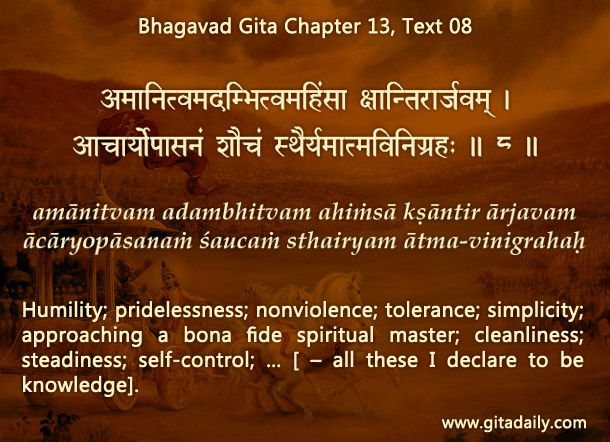
The Bhagavad Gita (13.8) emphasizes humility as the first of 20 virtues that comprise the essence of wisdom. It is considered the doorway to wisdom, leading to the pursuit of truth. This pursuit of truth includes understanding the true nature of humility, which alone can open us to higher wisdom.
Summary:
- Humility frees mental space from the self-obsession induced by ego, enabling absorption in meaningful and worthwhile higher realities.
- When misunderstood or weaponized by those in power, humility can lead to submission to abusive authorities and facilitate a culture of normalized abuse.
- By understanding humility as described in the Bhagavad Gita—as the doorway to wisdom culminating in the pursuit of truth—we can internalize a healthy and empowering perspective on humility.
Think it over:
- Recollect an incident where humility enabled you to become more absorbed in a higher reality.
- Recall any situation where a misunderstood notion of humility perpetuated abuse by an authority.
- Reflect on how the Bhagavad Gita helps us cultivate a healthy and empowering understanding of humility.
***
13.08 Humility; pridelessness; nonviolence; tolerance; simplicity; approaching a bona fide spiritual master; cleanliness; steadiness; self-control; … [– all these I declare to be knowledge, and besides this whatever there may be is ignorance.]
Humility is a ….great virtue