
Break up with our mind or a break from our mind?
We can’t break up from our mind, yet we need to have breaks from our mind if we are serious about going up.
When we realize that we are in a relationship that harms us, wherein the obligations and pressures of the relationship repeatedly impel us to act in unproductive or counterproductive ways, we may seriously contemplate breaking up with the person. However, if the relationship is a committed long-term one or one that we are born into rather than one we have chosen, breaking up may not be possible or feasible.
At such times, we may consciously seek a break in that relationship to better understand who we are, where we want to go in life, and how that particular relationship fits with our identity, purpose, and values.
We need a similar dynamic when dealing with our relationship with our mind. Because the mind is inside us, we cannot break up with it—it will always be with us. At the same time, the mind’s influence on us can frequently be negative, sometimes even toxic.
The more we come to realize how problematic our relationship with our mind is—whether through personal reflection or the study of wisdom texts like the Bhagavad Gita—the more we need to act on that realization. Even though we can’t physically distance ourselves from our mind, we can and must seek breaks from it.
Taking breaks from the mind
The Bhagavad Gita (6.5) reminds us that it is our responsibility to elevate ourselves with our mind, not let ourselves be degraded by it. While the mind is not a physical entity, we can still create metaphorical breaks from its overbearing influence by engaging in activities that are both uplifting and appealing.
If an activity is uplifting but not appealing, the mind may resist it, making it difficult for us to engage deeply. Conversely, if an activity is appealing but not uplifting, it may only increase the mind’s control over us, as we become further subordinated to its whims. For an effective break, the activity must balance both qualities—uplifting us while being naturally engaging.
Over time, as we persist in such uplifting and appealing activities, we can gradually transcend the initial phase of the mind’s resistance and enter the “nectar” stage described in the Bhagavad Gita (18.37). Here, the mind becomes pacified and silenced, allowing us to experience freedom from its disturbances and absorption in higher realities.
Why breaks matter
Breaks from the mind are crucial because they give us the space to reflect on who we really are, what truly matters, and how we can align our lives with our identity, values, and purposes. By creating these regular breaks, we can also reassess how we relate to our mind and reorient our relationship with it in a healthier way.
If we let the mind completely dictate our choices, we risk becoming enslaved by its impulses, constantly at its mercy. However, with regular, meaningful breaks, we can pacify the mind and re-establish control over our inner world.
Summary:
- We cannot break up with our mind, but we can and must take breaks from it by engaging in activities that are both uplifting and appealing.
- Such breaks help us pacify the mind and provide the space to reflect on our identity, values, and purposes, reorienting our relationship with the mind in healthier ways.
- With these breaks, we can guide the mind constructively rather than being dominated by it, empowering us to progress spiritually and practically.
Think it over:
- Reflect on any incident when you realized that your relationship with your mind was becoming toxic.
- What does taking a break from the mind mean? Have you ever experienced such a break?
- List three activities that are both uplifting and appealing for you and can help you take regular breaks from your mind.
***
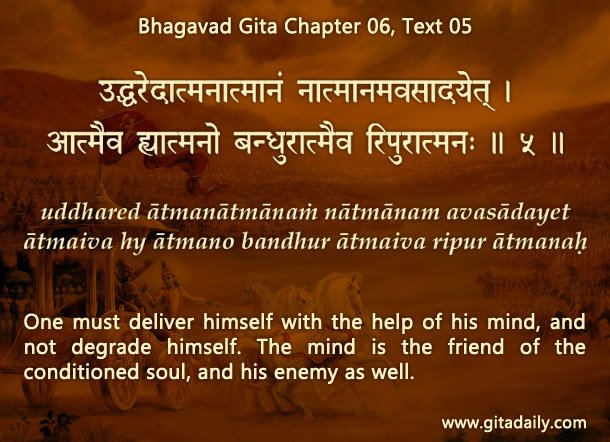
06.05 One must deliver himself with the help of his mind, and not degrade himself. The mind is the friend of the conditioned soul, and his enemy as well.
Hare Krishna Prabhuji,
Dandavat Pranam. I wanted to share this with you. Please read this write up below . I am sure you will be happy.
My Reflections connecting Nobel Prize physics 2025 and human consciousness😊 (composed with the help of Grok for smooth flow. Thanks Grok 🙂
———————————
The 2025 Nobel Prize in Physics, awarded to John Clarke, Michel H. Devoret, and John M. Martinis, unveils a marvel of the quantum realm: macroscopic quantum tunneling. In their groundbreaking experiments, superconducting circuits—housing billions of electrons united as Cooper pairs—defy classical barriers, slipping through forbidden walls with a shared wave function, their energy quantized like notes in a cosmic hymn. Where a ball thrown against a wall rebounds in the classical world, quantum tunneling allows it to pass through, as if guided by an unseen hand. The laureates’ triumph lies in scaling this phenomenon from the subatomic to the tangible, where entire circuits resonate with the fluidity of the quantum dance. This is not merely a leap for technology—heralding quantum computers and sensors—but a profound metaphor for the transcendence of consciousness, echoing the timeless wisdom of Sri Krishna in the Bhagavad Gita.
Consider the ball against the wall, bound by the Newtonian laws of action and reaction. In the quantum realm, however, particles transcend such limits, their wave-like essence permeating barriers with probabilistic grace. The Nobel laureates showed that even macroscopic systems, like Cooper pairs in a Josephson junction, embody this defiance, flowing as a singular entity through energy landscapes, unbound by classical constraints. So too does the Gita speak of the soul’s transcendence:
> tattva-vit tu mahā-bāho guṇa-karma-vibhāgayoḥ
> guṇā guṇeṣhu vartanta iti matvā na sajjate
> (Bhagavad Gita 3.28)
The knower of truth, Sri Krishna declares, rises above the interplay of material qualities (guṇas) and actions (karma), untouched by the world’s dualities. Just as quantum tunneling bypasses physical barriers, pure consciousness—when finely attuned—surpasses the cycles of cause and effect, crossing the boundaries of material existence to abide in its eternal essence.
This essence, the jīva or individual soul, is but a fragment of the divine, as Krishna reveals:
> mamaivāṁśo jīva-loke jīva-bhūtaḥ sanātanaḥ
> manaḥ-ṣaṣṭhānīndriyāṇi prakṛti-sthāni karṣati
> (Bhagavad Gita 15.7)
Though infinitesimal—described as one-ten-thousandth the tip of a hair—the soul’s consciousness, when aligned with the Supreme, radiates as sat-chit-ananda: eternal, cognizant, and blissful. Like Cooper pairs unified in a shared wave function, the soul’s effulgence permeates the entire being—body, mind, and senses—when focused on Krishna. The Nobel Prize’s revelation of macroscopic tunneling mirrors this: what was once confined to the microscopic now manifests on a grand scale, just as the soul’s divine nature, though subtle, can envelop the entirety of existence when awakened.
This parallel deepens with Krishna’s call to devotion:
> man-manā bhava mad-bhakto mad-yājī māṁ namaskuru
> mām evaiṣhyasi yuktvaivam ātmānaṁ mat-parāyaṇaḥ
> (Bhagavad Gita 9.34)
When thoughts, like scattered electrons, are fragmented by worldly distraction, they remain bound by material separation. But when directed toward Krishna, they coalesce—like Cooper pairs in a superconducting circuit—exhibiting the quantum-like unity of pure consciousness. This is raja-vidya, the kingly science of yoga, where the soul’s focus on the Supreme unlocks its true nature, transcending the barriers of illusion to merge with the divine flow.
The 2025 Nobel Prize thus becomes a scientific parable for the Gita’s eternal truth. Quantum tunneling, observed in macroscopic circuits, reflects the soul’s capacity to transcend material limits, its consciousness flowing unbound through the barriers of maya. As Krishna, the saccidānanda-rūpam, embodies eternal existence, knowledge, and bliss, so too does the jīva, in its infinitesimal form, when aligned with Him, radiate its divine potential. The laureates’ circuits, pulsing with quantized energy, are a material echo of this spiritual symphony—a reminder that even in the macroscopic, the quantum heart beats free.
Thank you very much.
Haribol !
MIND cannot remains sans thoughts