
When we feel tormented by desire, what can we do?
Indulgence in a desire may provide immediate relief from its torment, but it takes us further away from lasting release. Abstinence, on the other hand, offers no immediate relief but eventually leads to a complete release from that torment.
We have all experienced the torment of desire, especially with those desires that have grown strong and sharp due to repeated indulgence. For instance, an alcoholic may be deeply tormented by the urge to drink, whereas someone who has rarely or never consumed alcohol may not feel that torment at all.
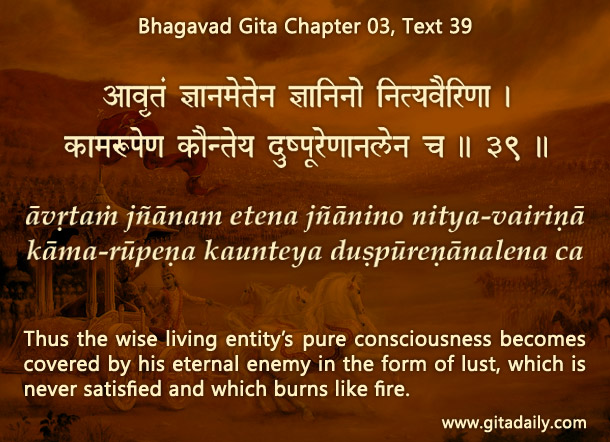
When desire burns within us, it feels like an internal fire. The Bhagavad Gita (3.39) compares such desires to an insatiable blaze. Indulging a desire might seem to extinguish the fire temporarily, offering quick relief. However, this relief is deceptive. Indulging is like throwing a block of wood onto the fire—it seems to dim the flames for a moment, but as the wood catches fire, the blaze grows even larger. Similarly, indulging fuels the desire, making it stronger and its torment more severe over time. For example, an alcoholic may feel relief after drinking, but the desire soon returns, fiercer than before, pulling them further away from the release they seek.
Abstinence, by contrast, denies immediate relief. It allows the fire of desire to burn uncomfortably for a time, but because it is denied additional fuel, the fire gradually diminishes and eventually dies out. While abstinence is initially tormenting, it moves us closer to lasting release, unlike indulgence, which delays and deepens our torment.
Thus, our essential choice is between short-term relief and long-term release. Seeking quick relief prolongs the torment and pushes release further away. Conversely, tolerating temporary discomfort through abstinence brings the moment of release closer.
Making abstinence bearable
How can we endure the torment of desire while practicing abstinence? Desire torments us most when our consciousness is idle and unoccupied. When our mind lacks meaningful engagement, it fixates on the torment, making it feel unbearable. However, when we immerse ourselves in meaningful and absorbing activities, our consciousness becomes occupied, leaving less room for desire to torment us.
The more we engage in meaningful activities, the less space desire has to torment us. With practice, we can make abstinence not only bearable but also empowering, as the fire of desire diminishes and ultimately vanishes. As our ability to focus on higher, meaningful engagements grows, we draw closer to the release we seek.
Summary:
- Indulgence may provide quick relief, but it fuels desire, making its torment worse and pushing the possibility of release further away.
- Abstinence denies immediate relief but gradually diminishes desire, leading to lasting release from torment.
- By immersing ourselves in meaningful activities, we reduce the mind space available for desire to torment us, making abstinence more bearable and effective.
Think it over:
- Why does indulgence feel good initially but harm us in the long run?
- Why does abstinence feel bad initially but ultimately help us?
- List three meaningful activities you can engage in to absorb your mind and make abstinence easier, thereby decreasing the torment of desire.
***
03.39 Thus the wise living entity’s pure consciousness becomes covered by his eternal enemy in the form of lust, which is never satisfied and which burns like fire.
JAPA avoids all torments