
Devotion is meant to bring about positive and powerful change, both internally within individuals and externally within society. However, devotion can sometimes have the opposite effect—causing disruption instead of contribution. This happens when practitioners, or worse, propagators of devotion, exhibit insensitivity, irrationality, or irresponsibility in their approach. Let us explore these pitfalls one by one and how they can be prevented.
Insensitivity in presenting devotion
When we experience the profound wisdom and transformative practices of bhakti, it is natural to feel enthusiastic about sharing it with others. While such enthusiasm is commendable, it can sometimes morph into over-enthusiasm, leading to insensitivity. This happens when:
We deride and dismiss everything apart from bhakti: Instead of explaining the glory of bhakti, we may end up portraying everything else as worthless or misleading, coming across as intolerant or extremist.
We impose unrealistic expectations on others: Rather than understanding others’ circumstances and providing a step-by-step path, we may label them as insincere if they don’t meet our standards. Such insensitivity alienates potential devotees and discourages practicing devotees.
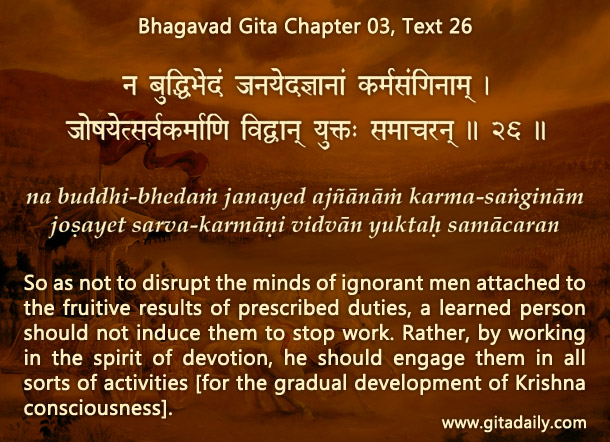
To avoid this, the Bhagavad Gita (17.15) advises that our speech should be truthful, helpful, pleasing, and non-agitating. Additionally, in 3.26, Krishna emphasizes guiding others in a way that elevates them gradually without excessive agitation.
Irrationality in pursuing devotion
Devotion can also lead to disruption when it becomes irrational. This occurs when we:
Reject reason and logic in the name of faith: While reason alone cannot lead to God, it plays a vital role in pointing us toward Him. When reason is downplayed or demonized, it opens the door to blind faith, which can make us gullible.
Fall prey to exploitation: Irrational devotion makes people susceptible to manipulation by political leaders inciting fanaticism or self-serving godmen preying on their wealth.
True devotion is trans-rational, not irrational. The Bhagavad Gita demonstrates this by systematically building a rational worldview and addressing logical questions throughout its teachings. It also presents the study of its wisdom as a devotional act (18.70), where reason serves as a tool for worship.
Irresponsibility in the name of devotion
Irresponsibility can manifest when people use devotion as an excuse to shirk their worldly duties. For example:
Pseudo-renunciates: Those who prematurely renounce their responsibilities, claiming spiritual advancement, often cause disruption in their families and social circles. This irresponsibility eventually undermines the faith of others when they observe a mismatch between the pseudo-renunciates’ words and actions.
The Bhagavad Gita addresses this by categorizing renunciation into three modes and discouraging renunciation in passion or ignorance (18.7-9). Genuine renunciation focuses on internal detachment rather than external abandonment. Additionally, Krishna advises those capable of renunciation to consider its societal impact before taking such a step (3.21-24).
Summary:
- Insensitivity: When devotion is presented insensitively, it alienates potential devotees and discourages practicing devotees.
- Irrationality: When devotion becomes irrational, it makes people gullible and vulnerable to exploitation by manipulative leaders or godmen.
- Irresponsibility: Using devotion as a justification to avoid responsibilities causes disruption in families, social circles, and the faith community.
Think it over:
- Have you observed someone being insensitive in presenting bhakti, causing disruption? How can you ensure your approach is sensitive and uplifting?
- Have you encountered irrational devotion leading to problems? How can you guard against such irrationality in your bhakti practice?
- Have you seen someone act irresponsibly in the name of devotion? How can you avoid such irresponsibility in your own life?
***
03.26 So as not to disrupt the minds of ignorant men attached to the fruitive results of prescribed duties, a learned person should not induce them to stop work. Rather, by working in the spirit of devotion, he should engage them in all sorts of activities [for the gradual development of Kṛṣṇa consciousness].
Leave A Comment