
Is the passive voice used to avoid blaming or evade taking responsibility?
In situations where something unfortunate has occurred, people often use the passive voice. Statements like “Mistakes were made,” “The judgment exercised was poor,” or “The oversight was deficient” shift attention away from specific individuals. While such phrasing may have a place when avoiding unnecessary harm to someone who made an honest mistake, it can also serve as a tool for evading responsibility—especially by those who should have acted better.
As conscious agents, we make choices, even if we are not always fully aware of their implications. Whether we initiate an action, approve it, or play any other role, we are involved in the decision-making process to varying degrees. Using the passive voice can obscure this reality and allow individuals to deflect accountability.
However, we are rarely the sole cause of any action. External pressures, ignorance, or unfortunate circumstances often shape our choices. Sometimes, a chain of events beyond our control can magnify the consequences of our actions. In such scenarios, blaming one person unfairly can lead to scapegoating, which is why a more nuanced and philosophical understanding of causality is crucial.
The Bhagavad Gita (3.27) describes how material nature influences actions, making it clear that multiple factors contribute to outcomes. Those with a divine disposition, as described in Bhagavad Gita (16.3), avoid fault-finding and refrain from harsh judgment, while those with a demoniac nature (Bhagavad Gita 16.4) are quick to assign blame, often with acrimony.
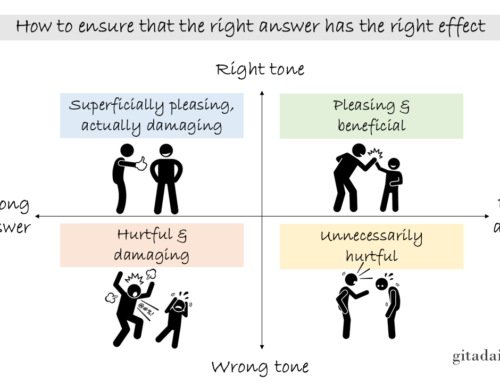
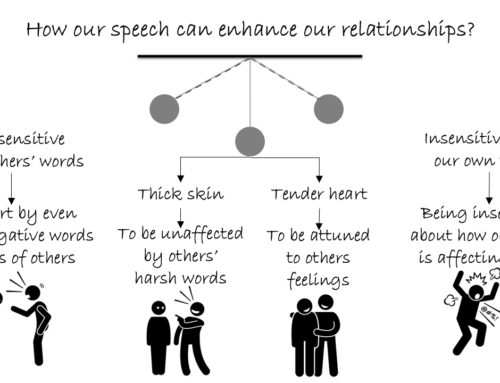
Additionally, Bhagavad Gita (17.15) advocates disciplined speech—urging us to be sensitive enough to avoid discouraging someone already feeling low and sensible enough to hold someone accountable when they attempt to dodge responsibility.
Summary:
- The passive voice can be used to avoid pinning blame when multiple factors contribute to a problem or to deflect attention from one’s role in a fiasco.
- Judging the appropriateness of using the passive voice requires a nuanced understanding of the broader context and the individual’s role.
- The divine part of us seeks to avoid blaming anyone unfairly, while the demoniac part looks to scapegoat others. The judicious part finds the balance between being sensitive and sensible.
Think it over:
- What are the two broad scenarios where the passive voice might be used in describing a fiasco?
- Reflect on a recent instance where the passive voice was used. Was its use appropriate? Why or why not?
- Consider a messy situation you are dealing with now. When would using the passive voice be wise, and when would it be unwise?
***
17.15 Austerity of speech consists in speaking words that are truthful, pleasing, beneficial, and not agitating to others, and also in regularly reciting Vedic literature.

Speech is Silvern .but Silence is Golden