
If we are gifted in any particular area, especially to an extraordinary degree, it can be easy to become proud. Such pride often leads to arrogance, which can make us dismissive, disrespectful, or even derisive toward those who don’t share the same level of ability. This arrogance, though it may stem from our extraordinary capability, makes us unappealing as individuals, even if our talent makes us appealing in certain respects. The Bhagavad Gita (16.4) warns that such arrogance is symptomatic of a demoniac nature.
Cultivating humility with honesty
Humility doesn’t require us to deny the presence of our ability. Denying what is evident is neither sustainable nor desirable. Instead, humility requires honesty—specifically, honesty about the source of our ability.
When we closely examine the process by which we perform exceptionally well, we may find that we are not as brilliant at explaining how or why we perform so brilliantly. If we are good with words, for instance, and can articulate ideas in catchy or creative ways, we may discover that these articulations seem to come to us rather than being the result of a purely logical or linear process.
The inability to replicate genius
Often, when trying to coach others to replicate our brilliance, we realize how difficult it is to get them to the same level, even with structured guidance. Talent, sensibility, and innate ability vary from person to person. While training can enhance someone’s aptitude to a degree, genius-level ability often defies simple replication. This realization further points us toward acknowledging that our abilities are gifts—not something entirely of our making.
Recognizing the source of our abilities
The Bhagavad Gita (15.15) states that intelligence, creativity, and ability ultimately come from the indwelling divinity. Similarly, in 7.8, Krishna encourages us to see abilities, including our own, as pointers to the divine. By recognizing that we are not the ultimate source of our abilities, but rather channels through which these abilities manifest, we can deepen our humility. Such recognition transforms what could have been a destroyer of humility into a builder of it.
Summary:
- Extraordinary ability can lead to pride, making us disrespectful, dismissive, or derisive toward others, thus diminishing our appeal despite our talent.
- True humility arises not from denying our ability but from a deeper honesty that recognizes its divine source—beyond our understanding and control.
- When we acknowledge that both our talents and the creativity to manifest them come from a higher source, the very abilities that could undermine humility instead strengthen it.
Think it over:
- Do you know someone whose extraordinary ability makes them appealing but whose arrogance makes them unappealing? Reflect on their example to understand the importance of humility.
- How does humility stem not from denying ability but from recognizing its true source? Contemplate how this honesty can help maintain humility.
- Reflect on an ability you possess. How can you view it through the lens of Bhagavad Gita wisdom to deepen your humility?
***
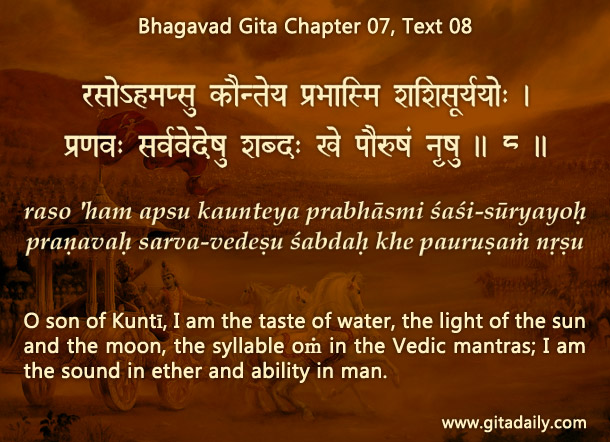
07.08 O son of Kuntī, I am the taste of water, the light of the sun and the moon, the syllable oṁ in the Vedic mantras; I am the sound in ether and ability in man.
Leave A Comment