
Free speech is not simply speaking whatever we want to speak. It is carefully speaking what needs to be spoken for a constructive effect.
We live in a culture where freedom of speech is increasingly valued—or devalued—depending on the political and cultural milieu of the times. Advocates for freedom of speech emphasize its importance in preventing thought monopoly in society. When one group monopolizes power, it can restrict what others speak about, and since serious thinking often occurs through speaking and discussion, such restrictions may also stifle thought, leading to tyranny.
On the other hand, those advocating regulation of speech argue that absolute freedom allows hate speech, enabling individuals filled with hate—whether due to momentary anger or deep-seated bias—to incite violence against those they dislike. Both extremes—tyrannical control over speech and absolute free speech—carry significant risks. A balanced approach is essential, acknowledging both the right to free speech and the hazards it may pose.
The Bhagavad Gita (17.15) highlights the importance of disciplined speech. It calls upon us to speak truthfully while being sensible, sensitive, and considerate of time, place, circumstance, and the individual receiving our words. This means free speech should not be mistaken as an unrestricted license to say whatever comes to mind. Instead, it calls for thoughtful deliberation—considering what we want to say, why we want to say it, and how to say it for maximum constructive impact.
Sometimes, speaking the truth may create disruptions or agitate people, but if it is likely to lead to greater good, such speech is justified. It must, however, be delivered in a measured way. A legal framework to regulate explicit calls for violence, combined with personal regulation to consider the context of speech, can foster a society that protects free speech while ensuring it remains effective and constructive.
Summary:
- The dangers of over-regulation of speech: Excessive restrictions on free speech can lead to the suppression of dissenting ideas, curtailing not only speaking but even thinking. This fosters tyranny, perpetuating the dominance of those in power.
- The dangers of unregulated free speech: Allowing all forms of speech under the guise of freedom can empower those with loud voices or large platforms to incite hatred and violence, opening the door to social unrest or even genocide.
- Balanced speech for constructive outcomes: A combination of legal regulations to prevent explicit calls for violence and personal regulations to ensure speech is truthful, helpful, and at least non-agitating allows free speech to have a constructive and beneficial impact.
Think it over:
- Reflect on an incident where those in power used restrictions on speech to suppress dissent. How did this demonstrate the dangers of over-regulation of speech?
- Recall an incident where individuals with influence used their platform to incite hatred or violence. How did this reveal the risks of unregulated free speech?
- Analyze a situation where you needed to speak strongly to someone. How could you moderate your words to ensure your speech has the most constructive effect?
***
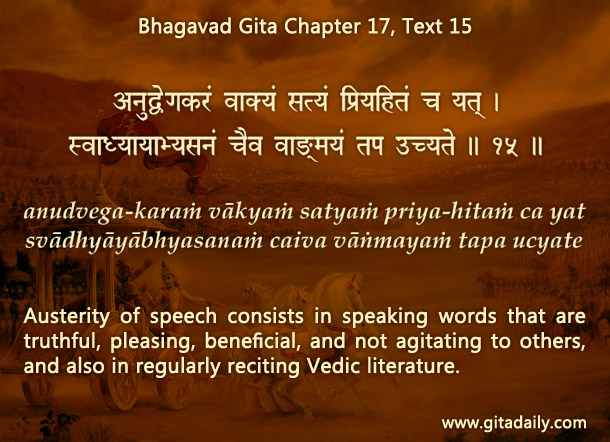
17.15 Austerity of speech consists in speaking words that are truthful, pleasing, beneficial, and not agitating to others, and also in regularly reciting Vedic literature.
Leave A Comment