
In real life, wisdom doesn’t appear to be uniformly distributed. Some individuals excel in academic fields but struggle in relationships, while others may have remarkable physical skills but lack intellectual capabilities. Similarly, a person insightful in analyzing complex subjects may be gullible when dealing with people. This raises the question: is wisdom subject-specific or universal? And how do we define a wise person if they exhibit glaring un-wisdom in certain areas?
Defining wisdom and its variability
The term “wise” is often used to describe a wide range of attributes. However, at its core, wisdom can be understood as the capacity to look beyond appearances and grasp the underlying substance. For instance:
In relationships, a wise person can listen for emotions and intentions beyond spoken words.
In science, a wise researcher perceives patterns and principles underlying observable phenomena.
This ability to see beyond the surface is frequently a result of past karma and is ultimately a gift from the divine. The Bhagavad Gita (7.10) states that Krishna is the intelligence of all intelligent people, emphasizing that all our capabilities come from him.
The role of karma and divine design
As described in the Bhagavad Gita (15.7), we are parts of the divine, and the intelligence we possess is a partial reflection of his infinite intelligence. However, the specific areas in which we excel are shaped by our past karma. Favorable karma in a particular domain results in heightened intelligence in that area, enabling us to perceive and understand things that others may not.
Modern psychology also classifies intelligence into various types, acknowledging that very few individuals exhibit high intelligence across all domains. Thus, one person may demonstrate exceptional skill in one field while being comparatively inept in another.
Humility and holistic growth
Recognizing the variability of our intelligence can foster humility. A meaningful life requires holistic growth—not just excelling in one area but reaching a basic level of competence across all significant areas. This broader growth becomes possible when we are humble enough to learn from others who excel where we do not.
The Bhagavad Gita (13.8-12) identifies humility as the first characteristic of wisdom. Metaphorically, if wisdom is a house, humility is the door to enter that house. By embracing humility, we can appreciate the extraordinary abilities in others as blessings that, when used constructively, benefit everyone.
The cooperative aspect of intelligence
The diversity in intelligence levels across various domains serves as a reminder of our dependence on God and the value of collaboration. When we see extraordinary intelligence in someone, we can view it as a collective blessing, meant to enrich everyone. Gratitude for our own gifts and appreciation for others’ talents can foster a cooperative spirit.
Summary:
- The essence of wisdom—seeing beyond appearances to substance—is a gift shaped by past karma. Intelligence varies across individuals and domains.
- God is the possessor of all intelligence in infinite measure, while we, as his parts, possess intelligence in specific areas as determined by our past actions.
- Recognizing our limitations fosters humility and dependence on God and others, while gratitude for our strengths inspires us to use our gifts constructively in service to others.
Think it over:
- Have you ever experienced being exceptionally sharp in one area and surprisingly inept in another? What insights can you gain from such experiences?
- How can you view your lack of intelligence in certain areas positively and use it as a basis for humility?
- Identify a domain in which you are gifted. How can you use this intelligence gratefully and constructively to serve and benefit others?
***
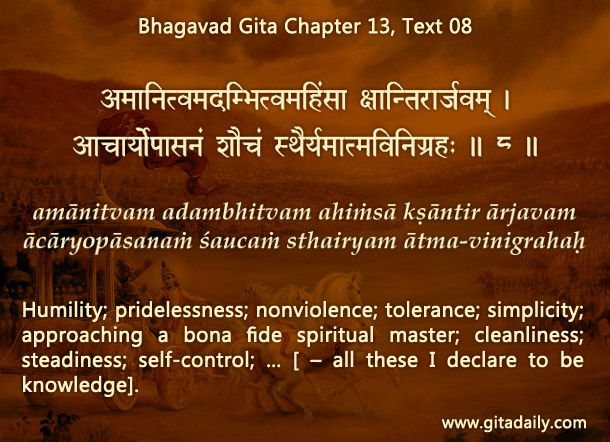
13.08 Humility; pridelessness; nonviolence; tolerance; simplicity; approaching a bona fide spiritual master; cleanliness; steadiness; self-control; … [– all these I declare to be knowledge, and besides this whatever there may be is ignorance.]
Leave A Comment