
If we consider our inner world as a territory where disputes occur, there are broadly two ways to address these disputes. The first approach is domination, where the opposing party is forced into submission through sheer power, often with threats of severe consequences for non-compliance. While this might be necessary in extreme situations, it is unsustainable for long-term harmony. True peace requires persuasion, not domination, to ensure that all elements coexist cooperatively rather than waiting for the dominating party to show any weakness.
The Bhagavad-gita’s guidance on dealing with the mind
The Bhagavad-gita acknowledges that the mind can act as an enemy (6.5), but instead of recommending that we crush it, the text encourages us to transform it into a friend. Domination over the mind may be necessary in situations where the mind, filled with self-destructive impurities, pushes us toward actions that could cause irreversible harm to our life or values. For example, if lust drives us toward immoral actions that could destroy sacred relationships, we must firmly and categorically reject such impulses without negotiation.
However, not all propositions of the mind are inherently harmful. The mind also harbors natural instincts and creative inclinations, such as a talent for music or writing. Even if these instincts don’t align with our current responsibilities, repressing them entirely can lead to suffocation and burnout. The Gita (6.17) recommends regulated recreation, reminding us that repression of natural tendencies can eventually backfire (3.34).
The balance of domination and persuasion
While dealing with our inner world, a one-size-fits-all approach of domination is neither practical nor effective. Instead, we need to employ persuasion to negotiate with both self-destructive impulses and self-expressive instincts. Persuasion involves allowing the mind some freedom within moral boundaries while guiding it toward constructive engagement. For instance, rather than completely crushing strong desires, we can channel them in ways that align with our values and long-term goals.
To engage in this inner negotiation effectively, we may initially need to use our intelligence to present compelling arguments to the mind about the dangers of indiscriminate indulgence and the benefits of self-discipline. Over time, as the mind begins to see how pursuing meaningful values brings greater fulfillment than fleeting pleasures, it will become more cooperative.
Winning the mind’s trust
When the mind observes that our disciplined actions lead to overall progress and personal fulfillment, it becomes persuaded to support us rather than resist. This state, where the mind ceases to act as an enemy and instead becomes a friend, represents the sustainable inner harmony advocated by the Bhagavad-gita.
Summary:
- In extreme situations, we may need to dominate our mind to firmly reject impulses that could jeopardize our life’s values and purposes.
- In other scenarios, persuasion through negotiation is more effective, enabling us to facilitate self-expressive instincts while regulating harmful impulses.
- By employing inner negotiation, we progress toward fulfilling meaningful goals, winning over the mind, and achieving sustainable harmony.
Think it over:
- Identify any indulgence your mind prompts you toward, where you need to apply domination, and plan how to be non-negotiably firm in such situations.
- List areas where domination would cause suffocation or rebellion and plan how negotiation can help balance these areas.
- Reflect on any indulgence your mind has already given up due to persuasion and visualize how to extend this approach to more contentious areas.
***
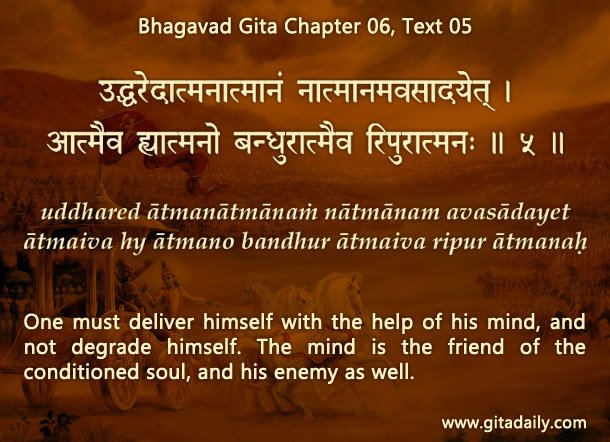
06.05 One must deliver himself with the help of his mind, and not degrade himself. The mind is the friend of the conditioned soul, and his enemy as well.
Leave A Comment