
Some of you have questioned my statement that this is not a religious issue. I wanted to keep the original video concise, so the context behind that statement may not have come across clearly. Let me now explain it more fully.
There are two distinct aspects to consider:
- What motivated the terrorists’ barbarity
- What should guide our response to it
My focus was primarily on the second.
Not a matter of religious identity
In responding to such attacks, both the mainstream media and even governments have, in the past, allowed themselves to be caught in the religious framework. Within that framework, there’s a fear: if we act strongly against attackers from another religion, we might be labeled religious bigots because we belong to a different faith. This fear distorts justice.
What I emphasized was that our response should not be shaped by religion-based identity politics. Instead, it should be shaped by principles, by a philosophical understanding of human nature.
The Gita’s framework: divine and demonic natures
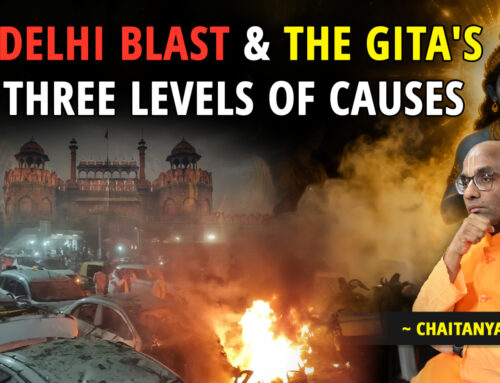
Rather than viewing this through a religious lens, I proposed we view it through the lens of the Bhagavad Gita, which speaks of divine and demonic natures. Demonic people are characterized by a perverse delight in cruelty—they celebrate inflicting suffering on others. This is exactly what the attackers did.
The Gita is unequivocal about such individuals:
They cannot be reasoned with or reformed through negotiation; they must be neutralized.
Why people become demonic – and why that’s not the immediate concern
Yes, it’s valid to ask: Why do people become demonic?
Some are driven by a lust for power. Others by toxic ideologies—religious or otherwise. Often, it’s a dangerous mix of both. In this case, the terrorists were motivated, at least partly, by their fanatical interpretation of their religion — as seen by their own words and actions.
These motivations matter in broader, long-term strategies. But when we are determining how to respond to a specific act of brutality, we need to be religion-blind—and treat it as we would any law-and-order issue.
The injustice of the double standard
If any other group committed such a heinous act of selective killing—say, if neo-Nazis today targeted a community as the Nazis did the Jews—the world would respond with complete unanimity, deploying the full might of the state to crush such forces.
That such unanimity is lacking today shows that a false narrative has taken root—a narrative that undermines justice and emboldens evil.
We need to reject that narrative.
Be unflinching in the face of evil
We must be unflinching in our resolve to stop such criminals—just as the president of El Salvador has done in his crackdown on brutal gangs. His example shows how swift, firm action can restore peace.
Kashmir had been on the path to such a restoration. This attack was intended to derail that progress. The disruptors of peace must be stopped. Period.
(This is a follow-up on my previous article and video on this issue)
Leave A Comment