
We may have to compartmentalize our life in terms of our activity, but we should not compartmentalize our life in terms of our identity.
In life, we often play multiple roles, and some of these roles may require us to act not just in different modes but even in opposing modes. For instance, at home, as a parent to a small child, we may need to be gentle and soft. However, at work, where competition can be bruising and even brutal, we may need to be firm, tough, and unwavering.
To manage these differing demands, compartmentalizing our life—mentally designating how we function in one area versus another—can be both desirable and essential. However, this compartmentalization must remain limited to our activities. It should not seep into our sense of self and create a split identity crisis, leaving us unsure of who we truly are.
The Bhagavad Gita highlights how such a crisis can manifest. Arjuna, caught between two roles, experienced an identity crisis. As a member of the Kuru dynasty, he wanted to protect his relatives. Yet, as a warrior, he was duty-bound to punish aggressors, even through violence or war. On the battlefield of Kurukshetra, these roles collided when his opponents turned out to be his relatives. The compartmentalization of his activities broke down, leading to an emotional and ethical crisis that spiraled into an existential crisis.
Arjuna’s turmoil gave rise to profound questions: How should one decide what is right? Is there anything truly right in a world so wrong? To resolve this, Krishna guided Arjuna toward a higher understanding—that he had a fundamental, unchanging identity beyond his societal roles. This spiritual identity, as the eternal soul, is explained in Bhagavad Gita 2.13. Further, in 15.7, Krishna describes all souls as parts of God, given various roles to play in the world. By focusing on this core identity, Arjuna learned to unify his conflicting roles and act with clarity and purpose.
Similarly, we too may face moments of conflict between our roles. For example, practicing spiritual life may focus on inner growth, while professional life may emphasize outer growth. This can create the feeling of living a double life, tempting us to believe we must abandon one to stay true to the other. However, our goal should not be loyalty to our roles but loyalty to our spiritual identity. As spiritual beings, we can practice spirituality inclusively, allowing it to harmonize rather than reject the material aspects of our life.
Our spiritual practice need not demand renunciation of the world but instead prioritization of our connection with Krishna. While others may seek outer growth for material gratification, we can pursue it as a means to serve Krishna. By using the resources and abilities we attain in his service, we can enrich both our spiritual connection and our material contributions.
Whenever we feel conflicted or confounded by the demands of our roles, we can return to our spiritual identity. From this foundation, we can function effectively even in challenging times by contextualizing and harmonizing our roles under the unifying purpose of serving God.
Summary:
- Playing multiple roles often necessitates compartmentalizing activities, but this should not extend to our sense of identity.
- The Bhagavad Gita teaches that situating ourselves in our fundamental spiritual identity as eternal parts of God can prevent identity crises when roles conflict.
- By prioritizing our relationship with Krishna, we can unify our roles and prevent compartmentalization of activities from degenerating into contradictions in identity.
Think it over:
- Contemplate two roles you are playing where compartmentalization of activities helps you function better.
- Reflect on a time when compartmentalization extended to identity, leading to a sense of crisis.
- Drawing from the Gita’s wisdom, outline three steps you can take to prevent compartmentalization of activities from degenerating into contradictions in identity.
***
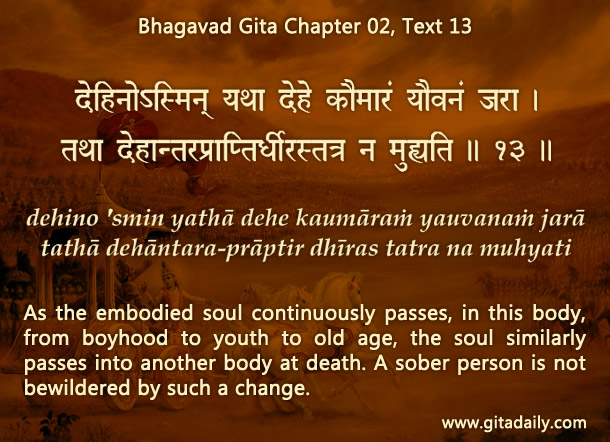
02.13 As the embodied soul continuously passes, in this body, from boyhood to youth to old age, the soul similarly passes into another body at death. A sober person is not bewildered by such a change.
Hare Krishna Dandavat prabhu . Thank you for nice article
JAPA guides you in crisis