
When we strive to improve ourselves, we often encounter internal resistance—our mind obstructs and even sabotages our progress. When such resistance happens repeatedly and relentlessly, discouragement can set in. We may start thinking, “Maybe this is just who I am. Maybe I will never be able to improve.”
Thankfully, we are not alone in our battle with our inner obstacle creator—the mind. The omnipotent and omniscient divinity is always present within us and active around us. By his grace, we receive insights and inspirations for dealing with our mind from various sources, often unexpected. These could be:
- A point heard in a talk.
- An observation made during the course of daily life.
- An idea that suddenly pops into our consciousness.
- A casual remark from someone that sparks a helpful thought.
These inspirations are gifts, and how we respond to them is crucial. We could either view them pessimistically, thinking, “It probably won’t amount to much; I’ve tried so many things before, and nothing really works in the long run,” or we could embrace them optimistically, saying, “This is more than I had before. I’ll take it, work with it for as long as it helps, and when it stops working, I’ll find something else.”
Such an optimistic attitude isn’t naive or unrealistic. It mirrors the strategy of armies engaged in prolonged wars. In these wars, neither side expects a decisive victory from one weapon or tactic. Instead, they keep developing and using new weapons, switching to the next one when the previous becomes ineffective. Similarly, in our internal war, we shouldn’t expect a single insight or inspiration to permanently transform us. Instead, we should value and utilize whatever helps us, for as long as it helps, before moving on to something else.
Avoiding extremes in self-improvement
One extreme is hoping for a magical solution—a single insight or inspiration that will instantly and permanently transform our inner world. This unrealistic expectation leads to discouragement and even despair when no such miracle materializes.
The other extreme is thinking that no effort is worthwhile because no single solution will last forever. This perspective leads to apathy and giving up entirely.
The balanced middle path is to acknowledge the reality of prolonged struggle. Insights and inspirations are like weapons in a long war: they are valuable for the time they work. When one becomes ineffective, we switch to another. This approach requires flexibility and gratitude.
Insights and inspirations in practice
This doesn’t mean we need to change our foundational practices for self-improvement, such as meditation or journaling. Instead, it means we might need to refresh the way we think about or approach these practices. For example, the inspiration that motivates us to meditate today may lose its effectiveness over time. When that happens, we need to find a new perspective or reason to keep going, rather than abandoning the practice altogether.
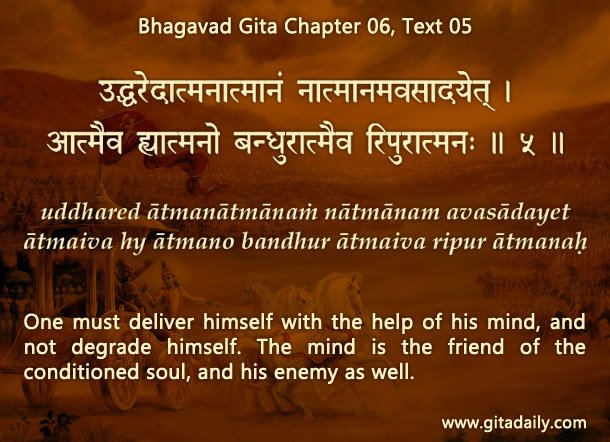
The Bhagavad Gita (6.5) reminds us that it’s our responsibility to elevate ourselves with our mind and not let it degrade us. This means we must continually seek insights and inspirations that keep us motivated. By doing so, we can maintain our commitment to self-improvement without succumbing to discouragement.
Summary:
Self-improvement, particularly overcoming deep-rooted unhealthy habits, is like a prolonged war. A single weapon or insight is unlikely to guarantee decisive or permanent victory. However, this doesn’t diminish its value. By gratefully using insights and inspirations as long as they work, and being ready to shift to new ones when needed, we can persist in our efforts without losing hope.
Think it over:
- When you receive a new insight or inspiration for self-improvement, what are two ways you could respond? Which response is your default?
- Using the war metaphor, explain why insights and inspirations that work today may not work tomorrow and why this shouldn’t discourage you.
- Identify the two extremes in the pendulum of self-improvement—over-expecting or undervaluing—and analyze which extreme you tend to lean toward. List three ways to bring yourself to the balanced middle path.
***
06.05 One must deliver himself with the help of his mind, and not degrade himself. The mind is the friend of the conditioned soul, and his enemy as well.
JAPAhelp avoid you the pessimism