
Bhagavad Gita 18.7
niyatasya tu sannyāsaḥ
karmaṇo nopapadyate
mohāt tasya parityāgas
tāmasaḥ parikīrtitaḥ
Duty’s work should not be cast aside.
Renouncing it due to delusion’s tide—
Such giving up out of laziness,
Is called renunciation in darkness.
My dear Lord, the world is filled with temptations that come in many garbs. The urges that draw me toward pleasure are easy to identify as temptations. But the urges that draw me away from pain—even when that pain is essential for my duties and desirable for my growth—are much more difficult to recognize as temptations.
O omniscient Lord, you repeatedly exhort me to rise beyond the world’s dualities such as attachment and aversion. Frequently do I pray for protection from the attachment that impels me toward whatever feels pleasant. In contrast, rarely do I pray for protection from the aversion that impels me away from whatever feels unpleasant—because I mistake such aversion for renunciation.
O omnipotent Lord, who can dissect and dismantle all illusion, help me differentiate renunciation from aversion. Let me see that aversion arises from the material consciousness that labels certain things as undesirable. More importantly, let me see that renunciation arises from the spiritual consciousness that sees all of material reality to be unworthy of my deepest desires; you alone are worthy of those desires. May my cultivation of renunciation aid my consciousness in turning toward you, free from the world’s shackles.
O Lord of all emotion, please fill my heart with attraction for you. And may that devotion crowd out all the emotions that entangle me in this world—not just those born of attachment, but also those born of aversion.
***
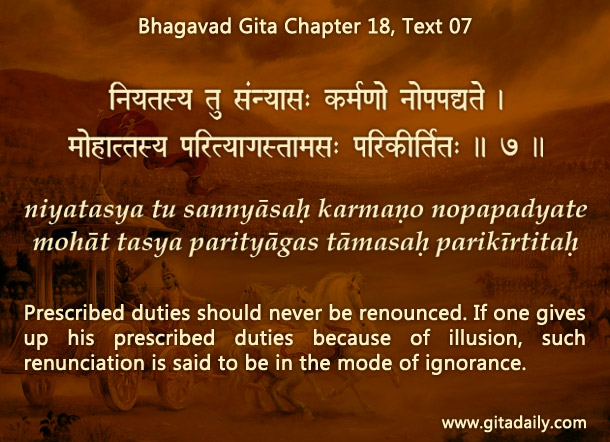
18.07 Prescribed duties should never be renounced. If one gives up his prescribed duties because of illusion, such renunciation is said to be in the mode of ignorance.
Leave A Comment