
Faith and spiritual growth often raise a timeless question: is spirituality best experienced in solitude or within a community? For many seekers, spiritual progress requires stepping away from the hustle and bustle of contemporary life. In solitude, distractions from people’s expectations and desires seem to dissipate, offering a clearer focus on inner growth. Indeed, the Bhagavad Gita (13.10) acknowledges staying in a secluded place as a characteristic of those who value and pursue wisdom.
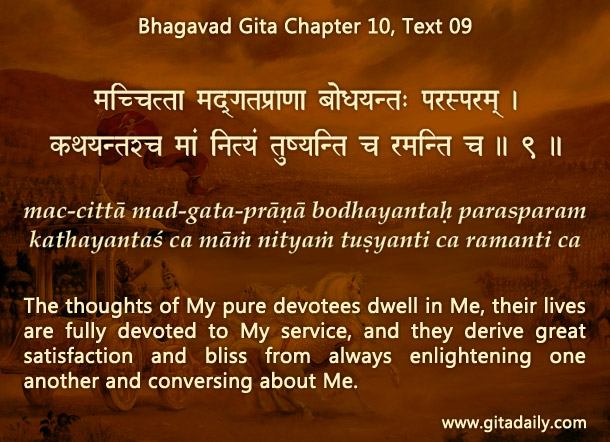
Yet, solitude isn’t always sufficient. Many find that their spiritual journey is better stimulated and sustained when they are with others who share similar aspirations, especially those further along the path. This dynamic interplay between solitude and community brings depth to spiritual practice and is emphasized across spiritual traditions. The Bhagavad Gita (10.9) celebrates the joy that arises when seekers share their spiritual experiences in fellowship.
Ultimately, the question of whether spirituality is a shared or personal experience depends on how we perceive and pursue it. Let’s explore how solitude and community intersect in spiritual growth.
Solitude and its insights
In solitude, spiritual seekers often delve into their inner world, free from external noise. For those inclined toward introspection, solitude provides a space to reflect deeply, connect with the divine, and gain personal clarity. However, prolonged solitude can have drawbacks. It can leave us alone with our mind, which, if dominated by materialistic tendencies or even antispiritual inclinations, can hinder spiritual progress.
Solitude thus serves best as a tool for self-discovery and rejuvenation, particularly when balanced with other forms of engagement.
Community and its support
While solitude offers reflection, community provides encouragement and reinforcement. Being around like-minded spiritual seekers creates an environment of shared purpose, where insights and experiences are amplified through collective practices such as singing hymns, studying scripture, or engaging in service. Witnessing the experiences of others can strengthen our conviction and inspire our journey.
However, over-reliance on community may foster unhealthy dependence. Outsourcing motivation to others can become counterproductive if it prevents us from taking personal responsibility for our spiritual growth.
Community, therefore, acts as a support system rather than a substitute for individual effort.
Balancing solitude and community
The divine can manifest through both solitude and community, and each seeker needs to find a balance that suits their nature and circumstances. Introverts may require solitude to recharge before engaging in a community, while extroverts may thrive in fellowship and seek solitude only occasionally.
Understanding this balance involves recognizing that spirituality is not a compartmentalized experience. Instead, it is a dynamic relationship with the divine, who acts through solitude, community, and the interplay of the two. The Bhagavad Gita teaches us to value both aspects and encourages us to harmonize them for holistic growth.
Summary:
- The spiritual journey is enriched by both solitude and community. Solitude provides space for introspection and connection, while community fosters encouragement and shared growth.
- Spirituality should not be compartmentalized into watertight categories. Instead, it should be viewed as a dynamic interaction with the divine, manifesting through various channels.
- Each seeker needs to find their own balance. This depends on their disposition (introverted or extroverted) and circumstances, ensuring their spiritual growth is both personal and communal.
Think it over:
- What are the risks of viewing spirituality as confined to either solitude or community?
- Recall a time when solitude brought you spiritual insights. How can you maximize your receptivity to spirituality in solitude?
- Reflect on an instance when community inspired your spiritual growth. How can you enhance your receptivity to spirituality in a communal setting?
***
10.09 The thoughts of My pure devotees dwell in Me, their lives are fully devoted to My service, and they derive great satisfaction and bliss from always enlightening one another and conversing about Me.
Leave A Comment