
Bhagavad Gita 11.42
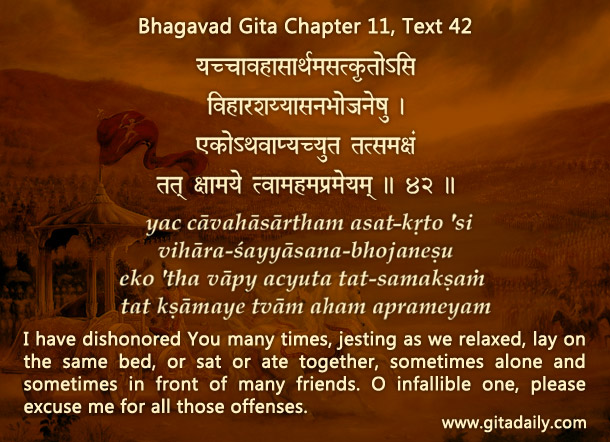
yac cāvahāsārtham asat-kṛto ’si
vihāra-śayyāsana-bhojaneṣu
eko ’tha vāpy acyuta tat-samakṣaṁ
tat kṣāmaye tvām aham aprameyam
While playing or dining, if ever I spoke amiss,
In jest during intimate moments like this;
Deeds done alone or before many eyes,
Forgive me, O Lord boundless and wise.
My dear Lord, when Arjuna realizes your greatness, he immediately apologizes for having transgressed proper etiquette while interacting with you as a friend. Similarly, forgive me for having taken so casually, for so long, your many merciful manifestations—your holy names, your deities, and your sacred scriptures.
O omnipresent Lord, I seek your forgiveness not because you will punish me for treating you trivially, but because I have realized that whenever I devalue you, I unknowingly punish myself by robbing my life of enduring value. Once I forget or neglect you, whatever I do tends toward tragedy. While some actions are so self-destructive that they lead to visible tragedy, most actions done in forgetfulness of you lead me to chase what is ultimately frivolous. Such persistent pursuit of triviality slowly turns my life itself into a tragedy.
Bless me, O infallible Lord, to approach your glory with reverence and gravity. Help me appreciate that the more seriously I seek to perceive your presence and pursue your purpose in my life, the more you bring enduring value into my life. For you make each moment lived in consciousness of you worth living—transforming it from yet another experience that came and went into an experience that brought me closer to you, who prevail above all things that come and go.
***
11.42 I have dishonored You many times, jesting as we relaxed, lay on the same bed, or sat or ate together, sometimes alone and sometimes in front of many friends. O infallible one, please excuse me for all those offenses.
Leave A Comment