
The word fire has multiple meanings: a natural force that burns, the dismissal of someone from their job, and an energizing enthusiasm or motivation (as in being “fired up”). All these meanings can be applied metaphorically to our inner world and the ways we address our desires.
The Bhagavad Gita (3.39) describes self-destructive desire as a fire that burns insatiably. We can observe its relentless nature when we consider how intolerable desires feel as they torment us internally, impelling us toward indulgence. Even when we succumb, the satisfaction is fleeting; the fire quickly reignites with greater intensity and fury, leaving us tormented anew.
However sobering or even alarming this reality may be, there is also an encouraging truth: our inner world possesses firefighting forces. The Bhagavad Gita (3.43) calls upon us to use our intelligence to situate ourselves in transcendence and thereby conquer this inner enemy. Yet, this same text (3.40) warns that intelligence itself can be corrupted by self-destructive desire. The influence of such desire may begin with the senses, spread to the mind, and ultimately consume even the intelligence.
When intelligence is corrupted, it may rationalize indulgence, enabling discreet indulgences to preserve reputation or justifying actions with brazen arguments when confronted. Such a corrupted part of our intelligence is akin to a firefighter who protects the fire rather than extinguishing it or who becomes an arsonist. This part of the intelligence needs to be fired—dismissed immediately and unsparingly.
To do this, we must confront such corruptions with logic and scripture. By systematically noting and refuting the rationalizations that justify indulgence, we can prepare ourselves to resist future temptations effectively. The Bhagavad Gita (2.63) warns that once intelligence is compromised, we are likely to fall entirely, as intelligence is the final bulwark protecting us from self-destruction.
While corrupted parts of our intelligence must be fired, the competent parts need to be fired up—enthused and empowered. This is achieved by providing our intelligence with the resources and confidence necessary to combat self-destructive desires. Spiritual wisdom plays a crucial role here, particularly the insights from Bhagavad Gita (2.59), which recommend cultivating a higher vision.
This higher vision includes understanding our spiritual identity and recognizing that true satisfaction can only come from spiritual fulfillment. Moreover, it involves recognizing our eternal relationship with the all-attractive and merciful divinity, Krishna, who is eager to empower us in our struggle. Krishna is not only the ultimate game changer but also the ultimate game ender. By focusing our consciousness on him through remembrance and service, we invite a merciful flow of higher energy and insight that exposes and expels self-destructive desires.
Fighting self-destructive desires is often a prolonged war, but as long as our vision remains fixed on Krishna, who endlessly energizes us, our intelligence—and, by extension, our entire being—can be sufficiently fired up to persist until victory is achieved.
Summary:
- Self-destructive desire is like a relentless fire that indulgence cannot extinguish but temporarily appeases, only for it to return with greater intensity.
- Intelligence, a key member of our inner firefighting squad, can be corrupted, rationalizing indulgences or justifying misdeeds. Such corrupted parts need to be “fired” through rigorous refutation using logic and scripture.
- The competent parts of intelligence must be “fired up” with spiritual wisdom, focusing on our spiritual identity and relationship with Krishna, who empowers us to overcome self-destructive desires.
Think it over:
- Have you experienced self-destructive desire as an insatiable fire? Reflect on how it felt and the impact it had on your inner world.
- Contemplate whether any part of your intelligence needs to be fired. Note down the scriptural and logical refutations you can use to counter its covert schemes and overt rationalizations.
- Consider how you can fire up the competent parts of your intelligence by reflecting on reasons that inspire commitment, confidence, and conviction to fight against self-destructive desires.
***
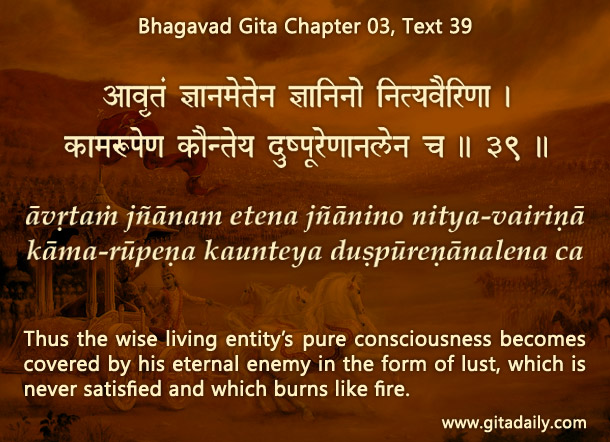
03.39 Thus the wise living entity’s pure consciousness becomes covered by his eternal enemy in the form of lust, which is never satisfied and which burns like fire.
Leave A Comment