
The mind is meant to be the complement to the intelligence, let it not become the replacement of the intelligence
We live in an age where mental health challenges are increasing at an alarming rate. Deprived of inner peace and satisfaction, many are turning to spiritual practices and insights to better manage their minds. Several spiritual traditions strongly caution practitioners about the “monkey mind,” emphasizing that it can be not just restless but also reckless, with the potential to ruin our lives.
The mind is often associated with desires and feelings and can be impulsive and fickle. When people hear, for instance, the Bhagavad Gita’s caution that the mind can be our worst enemy, they sometimes fear such strong condemnations could lead to a one-sided approach. This might result in individuals repressing or suppressing their emotional side, potentially stunting emotional growth while believing they are advancing spiritually.
However, such concerns arise only from misunderstandings or misapplications of the Bhagavad Gita’s teachings. The Gita provides a holistic perspective. The same text that warns us of the mind’s potential as an enemy (6.5) also informs us that the mind can be a friend. It urges us to formulate a relationship with the mind that elevates rather than degrades us. If the goal is to befriend the mind, the process cannot involve repressing or suppressing it.
Yes, the mind is associated with our emotional faculty, while the intelligence is primarily associated with the rational faculty. Ideally, the mind complements the intelligence, just as emotion is meant to complement reason. Unfortunately, when the mind is not properly managed, it can become unrestrained, sidelining and silencing the intelligence to take over as the sole decision-maker. Emotions should inform our decisions, not form our decisions. When the emotional faculty monopolizes decision-making, we end up making ill-considered, short-sighted, or even self-destructive choices. At times, we may not make any decisions at all, as the impulsive emotional side overwhelms the reflective rational side, leaving it unprepared or undeveloped.
That is why the call to control the mind is so significant. This does not imply that our emotions should be suppressed or that the mind should be eliminated. A fully developed person has both their emotional and rational sides well-developed and well-integrated, enabling them to make sound decisions that align the head and the heart—emotion and reason.
Such integration is also emphasized in the Bhagavad Gita, which calls for offering both the mind and the intelligence in a mood of service to the Divine. Through this alignment, individuals can achieve holistic inner development.
Summary:
- With rising mental health challenges, two broad approaches have emerged: one emphasizing the discipline of the mind to avoid chaos, and the other cautioning against suppressing the mind to prevent mental health issues.
- The Bhagavad Gita reconciles these concerns by stating that the mind is a vital part of our inner world, which should complement the intelligence rather than replace it. Discipline ensures that the mind informs decisions without monopolizing them.
- Full inner development happens when the mind and intelligence, along with their emotional and rational faculties, are well-developed and synergized in a mood of service to the Divine.
Think it over:
- Reflect on the consequences of letting the mind dominate unchecked. Have you experienced such consequences in your life?
- Consider the outcomes of suppressing the mind. Have you ever encountered this, and what were the effects?
- What is the Bhagavad Gita’s vision of holistic inner development? What steps can you take to cultivate balanced growth of both your emotional and rational faculties?
***
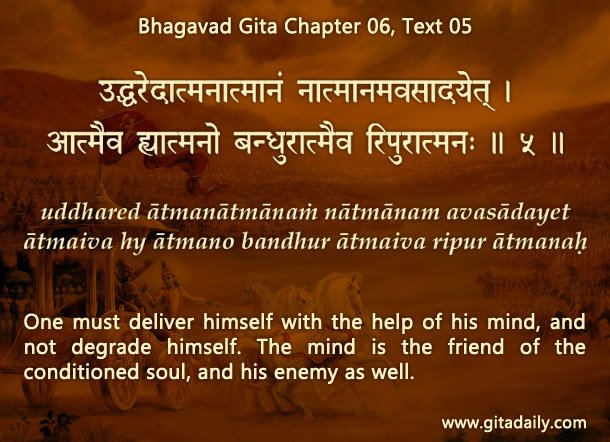
06.05 One must deliver himself with the help of his mind, and not degrade himself. The mind is the friend of the conditioned soul, and his enemy as well.
Leave A Comment