
What makes life dangerous is not just outer threats, but inner traitors
What makes life truly dangerous is not merely the external presence or occurrence of things that can harm us but the internal dominance of factors that make us vulnerable to those threats. A country is endangered not just by external enemies who attack it but also by the prevalence of inner traitors who weaken its defenses.
Many of the world’s greatest wars have been won not simply because invaders were skilled at defeating the defending army but because they exploited the presence of insiders who betrayed their own nation. If a country is not vigilant in identifying and neutralizing such traitors, it becomes increasingly vulnerable, often turning into an easy target for external foes.
The same dynamic applies to us in our battles against temptation. An alcoholic is destroyed not so much by the presence of a bottle of alcohol outside but by the presence of the urge to consume alcohol inside their consciousness. Similarly, our inner weaknesses—unregulated desires and temptations—serve as traitors that undermine our integrity and self-control.
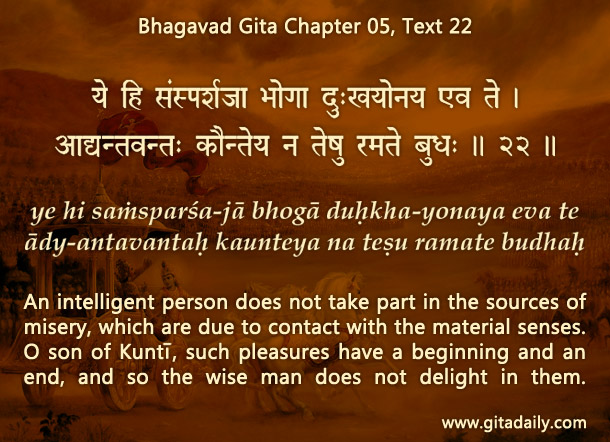
However, the difficulty in identifying such inner desires as traitors lies in their deceptive nature. They appear as friends, promising immediate pleasure. But, like traitors, they mask their true intentions. The pleasure they promise is fleeting and superficial, often followed by a long tail of trouble—whether in the form of regret, harm, or consequences that spiral out of control. The Bhagavad Gita (5.22) cautions that wise individuals refrain from indulging in such pleasures, just as wise rulers would not trust traitors.
To protect ourselves from these inner enemies, we need a three-pronged approach summarized by the acronym TIE: transcendence, intelligence, and experience.
Transcendence: By connecting with a higher reality through spiritual practices, we experience a deeper and more fulfilling happiness that reduces our tendency to turn to material indulgences for satisfaction.
Intelligence: By studying wisdom texts like the Bhagavad Gita, we sharpen our understanding of the deceptive nature of temptations, making it easier to recognize and resist them.
Experience: By reflecting on past disappointments and betrayals caused by indulgence, we reinforce our conviction that such actions lead to trouble and not true happiness.
This combination of transcendence, intelligence, and experience equips us to expose and neutralize the inner traitors that open the gates of our consciousness to harmful temptations.
Summary:
- Just as a country must guard itself against both external aggressors and internal traitors, we must protect ourselves from not only outer tempting objects but also inner desires that invite those temptations.
- Inner desires act as traitors by pretending to be friends, promising fleeting pleasure but ultimately leading to significant harm and regret.
- We can counter these inner traitors using the three-pronged strategy of TIE: cultivating transcendence through spiritual practices, sharpening intelligence through wisdom texts, and learning from past experiences of disappointment caused by indulgence.
Think it over:
- Why do we often fail in our battles against temptation?
- Can you recall a recent incident when you realized you were betrayed by your desires?
- How can you apply the TIE strategy to identify and eliminate the inner traitors in your life?
***
05.22 An intelligent person does not take part in the sources of misery, which are due to contact with the material senses. O son of Kuntī, such pleasures have a beginning and an end, and so the wise man does not delight in them.
JAPA annihilates inner traitors