
How spirituality, meditation and bhakti are related
When we take a life of deeper meaning or higher purpose, we may encounter many terms that seem broadly connected with such a higher journey, but we may not be clear about their specific significances.
Let’s look at three such terms: spirituality, meditation, and bhakti.
While each of these terms can be used in different senses by different people in different contexts, we will explore what they mean in the light of the wisdom of the Bhagavad Gita, especially for those who are seekers of a life of deeper meaning.
Spirituality
Spirituality refers to the exploration of spiritual reality. Such an exploration helps us get a sense that there are existing things which are far more enduring—indeed, everlasting—contrasted with the things in the visible or material world around us, which are often fleeting and at least non-enduring.
Just as those who live in a temporary house seek a permanent home, spirituality informs us that there is indeed a vast, unexplored domain of reality that is far grander and greater than the visible reality we pursue and that pursues us.
Meditation
Building on the insight about the existence of an enduring reality provided by spirituality, meditation provides us with specific practices that enable us to focus on and link with that lasting reality.
While there can be many different forms of meditation—both in terms of the mode of practice and the conception of the object of meditation—one essential unifying feature is that it involves some guiding process that equips us to shift our attention, especially our mind, from the changing to the unchanging.
Through the practice of meditation, we start realizing and relishing the unchanging reality that spirituality informs us about and that we explore.
Bhakti
Building on what meditation provides us, bhakti offers the enriching and empowering revelation that the higher reality we are seeking to reach is not just everlastingly stable but also endearingly reciprocal.
The ultimate spiritual reality is not just an unchanging, passive existence at a higher level of consciousness. It is also a personal divinity seeking to reach out to us.
If we consider the spiritual journey to be like climbing up a mountain, bhakti reveals that the ultimate spiritual reality is not just a majestic mountain peak we need to reach by strenuous effort. It is also a living, loving personal divinity extending its hand from that mountain peak down to us to raise us up.
Appreciating the reciprocity of the ultimate spiritual reality brings a whole new dimension of ease and excitement into our spiritual journey as we try to establish a personal connection with the Divine reality. Through bhakti, we experience reciprocal grace that propels us forward faster than we might normally be able to push ourselves.
Summary:
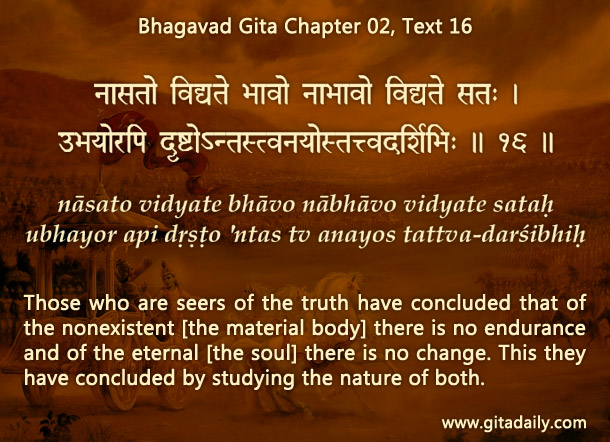
- Spirituality informs us that there is an entire domain of reality that is enduring, even everlasting, as contrasted with the impermanent nature of material reality that normally occupies our mind (Bhagavad Gita 2.16).
- Meditation equips us with specific practices to shift our focus from the ever-changing reality around us to the unchanging spiritual reality.
- Bhakti propels our spiritual journey by revealing that the ultimate spiritual reality is not a distant peak to struggle toward but a living, loving personal divinity extending a helping hand to raise us to ever higher levels of realization and satisfaction.
Think it over:
- What is spirituality, as understood through the Bhagavad Gita’s wisdom? Have you realized the reality of spirituality?
- What is meditation? Have you had any special experiences through your meditational practices?
- What is bhakti? Have you ever experienced a special enrichment that comes through the practice of bhakti?
***
02.16 Those who are seers of the truth have concluded that of the nonexistent [the material body] there is no endurance and of the eternal [the soul] there is no change. This they have concluded by studying the nature of both.
it is like as water. sugar dissolve in milk