
The distinction between maintaining appearances and outright hypocrisy lies in the presence of some substance and an earnest effort to increase it. Hypocrisy arises when the facade exists solely to conceal the absence of substance, with no genuine endeavor to improve.
Everyone experiences, to some extent, a gap between their inner state and outward behavior. For instance, someone might put on a cheerful smile for a photo shoot while struggling with depression internally. Similarly, a spiritual aspirant may outwardly appear disciplined in controlling their senses while privately battling indulgence.
When does keeping up appearances become part of being a civil member of society, and when does it devolve into hypocrisy? Some justify this gap by claiming that private struggles should not be aired publicly and will resolve in due course. While this reasoning can be valid, it becomes problematic when it is used as a mask for outright deception.
The Bhagavad Gita (3.6) critiques this kind of duplicity, labeling those who pretend to have conquered their senses while secretly indulging as deceivers who mislead both themselves and others. Hypocrisy is marked not merely by a difference between inner and outer realities but by the deliberate effort to exaggerate outward appearances without making any attempt to align the inner reality.
For example, a person who neither believes in God nor makes any effort to develop faith but pretends to be a pious ascetic to exploit others embodies outright hypocrisy. In contrast, someone earnestly striving for self-control, with some basic level of progress, is not hypocritical. Such a person represents the human struggle of striving to live by principles while occasionally faltering.
This distinction underscores why accusations of hypocrisy should not be made lightly. Similarly, maintaining appearances should not become an excuse for concealing deceit. The key lies in finding a balance—acknowledging the difference between substance and appearance while striving sincerely to bridge that gap.
Summary:
Maintaining appearances can be justified as a way to handle personal issues discreetly and avoid unnecessary disruption. However, hypocrisy occurs when a person deliberately projects a virtue they lack and focuses solely on preserving the facade rather than cultivating the substance of that virtue.
A reasonable gap between appearance and substance is acceptable if there is some level of substance and an earnest effort to increase it. Hypocrisy begins when there is no effort to improve, and energy is spent solely on preserving appearances.
Finding a middle ground acknowledges the human struggle of striving to improve while preventing the misuse of appearances to conceal outright deception.
Think it over:
Recall an instance where keeping up appearances allowed a personal issue to be resolved discreetly without causing disruption.
Reflect on an incident where hypocrisy was justified as maintaining appearances and led to significant individual or social problems.
Consider a gap in your life between internal substance and outward appearance. Identify three tangible steps you can take to increase the substance of the virtue you portray.
***
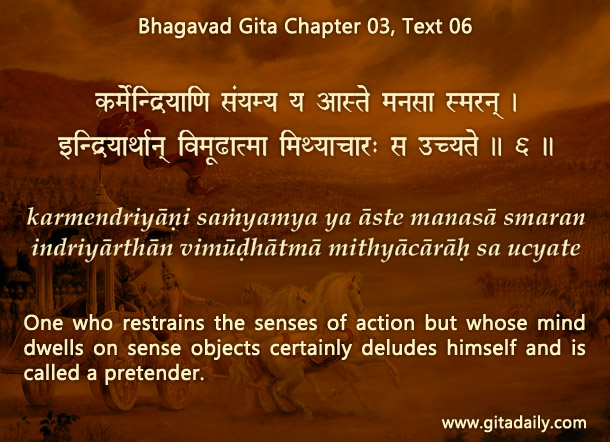
03.06 One who restrains the senses of action but whose mind dwells on sense objects certainly deludes himself and is called a pretender.
A dress is not an indication of Bhakti