
Whenever we indulge in a desire—whether it is to eat, watch TV, gossip, consume alcohol or drugs, or any other indulgence—we often perceive it as a small, casual, and inconsequential choice. We may think we can stop whenever we decide to, and since the pleasure gained seems harmless and not overly troublesome, we see no issue with the indulgence.
This perspective overlooks a critical aspect: how indulgence changes our inner world in subtle yet serious ways.
When we dwell on a tempting object, the path from contemplation to physical indulgence may initially seem like a flat surface. However, it is, in fact, a gently inclined surface. Once we begin the process of dwelling on an object, the incline starts moving us toward physical indulgence almost automatically. At first, the incline is mild, and with some effort, we can stop ourselves.
Yet, with repeated indulgence, this path becomes increasingly inclined, eventually turning into a steep slope akin to a mountain cliff. At this stage, as soon as the thought of indulgence arises, we find ourselves propelled toward physical gratification, often without full awareness or intent. This loss of control marks the state of addiction, where resisting the desire seems impossible.
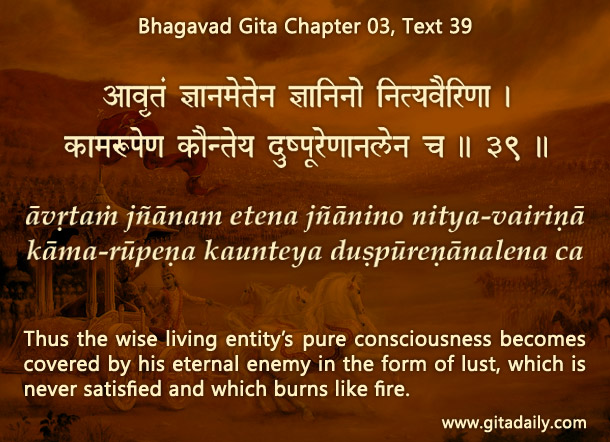
As the slope becomes steeper, the desire, upon appearing, starts tormenting us with such intensity that we indulge just to escape the unbearable torment. The Bhagavad Gita (3.39) describes such desires as an insatiable fire and warns that they are relentless inner enemies.
Most addicts fail to realize they have become addicted until they indulge in circumstances that are extremely embarrassing or where the costs of indulgence become shockingly high. It is only then that they recognize how uncontrollably powerful the desire has become.
For those not yet at addictive levels, each indulgence subtly increases the steepness of the path from contemplation to gratification. Recognizing this internal change can help us stop trivializing indulgence as inconsequential. Instead, we can make carefully considered choices to prevent ourselves from becoming ensnared in nearly inextricable habits.
Summary:
- When we repeatedly indulge in certain pleasures, we often trivialize these actions as casual and inconsequential, failing to notice the subtle but significant inner changes.
- Each indulgence transforms our inner landscape: the path from contemplation to gratification begins as flat, becomes a gentle incline, and ultimately sharpens into a steep slope akin to a mountain cliff.
- Recognizing these changes before embarrassing or painful consequences arise allows us to make mindful choices and avoid entanglement in nearly inextricable habits.
Think it over:
- Why might we dismiss repeated indulgence in some desire as harmless or insignificant?
- How does repeated indulgence alter our inner landscape, making desires harder to resist?
- Reflect on an incident where you indulged without awareness and faced embarrassing or painful consequences. How can this help you appreciate the gravity of repeated indulgence?
***
03.39 Thus the wise living entity’s pure consciousness becomes covered by his eternal enemy in the form of lust, which is never satisfied and which burns like fire.
Desires stymied our destinations