
All of us are affected by our past to varying degrees. Some of us may have incurred wounds so deep that we feel permanently damaged, as if our past will burden or even cripple us for the rest of our lives. While our past influences us in many ways, it’s important to clearly understand the extent of this influence—both the boundaries naturally present and the boundaries we need to establish.
To better grasp the influence of the past on the present, we can compare our mind, where many impressions from the past are stored, to our body, which also carries genetic and other influences from the past. Based on our past, such as the family we are born into, we may have a particular complexion we cannot change. However, we can change the expression on our face. Similarly, while it is untrue to say that nothing physical about us is determined by the past, it is equally untrue to think that everything about us is determined by it. Our past may control our complexion, but not our expression.
What applies to the body also applies to the mind, though in subtler ways. Our past experiences may make certain tendencies almost inevitable. For example, if we were burned by taking risks in the past, we may now feel averse to taking risks. If we were mistreated in a relationship, we might be overly cautious in forming new relationships. And if we were exploited by a so-called spiritual teacher, we may become hesitant to embrace any spiritual path. Such reactions are natural, but they do not mean we are permanently stuck. Being cautious or moving slowly is being constrained by our past; refusing to move at all is being contained by it.
If we compare our past to a shell, it may currently contain us, but growth requires breaking free from it. The time it takes to break free depends on how thick the shell is, how deeply we were hurt before forming it, and how long it takes for those wounds to heal. Yet, living inside the shell forever—especially if it inhibits or even prohibits us from enriching and meaningful experiences—is not truly living.
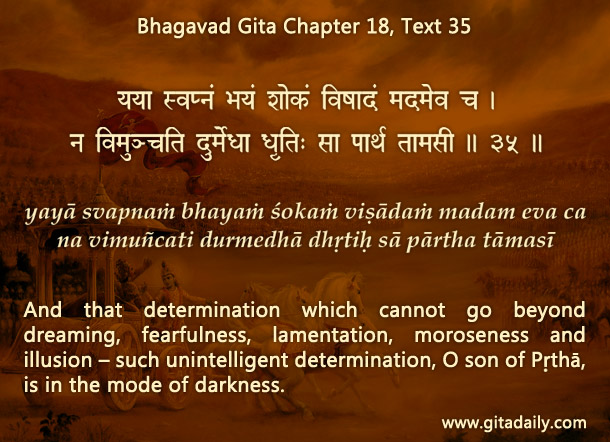
The Bhagavad Gita (18.35) warns against chronic lamentation over the past to the point of wallowing in it, calling this a misdirected determination fueled by the dark mode of ignorance. To manage our relationship with the past, we need to avoid two extremes. One extreme is denying the past’s influence altogether, believing we can do whatever we want, only to be paralyzed by sudden reminders of past conditioning. The other extreme is acting as if the past leaves us with no free will, allowing it to haunt and constrict us. In between these extremes lies the balanced approach: acknowledging the past’s influence while refusing to let it dominate us. This means taking slow, cautious, incremental steps in areas where we feel apprehensive.
Here, adding a devotional dimension to life can be immensely helpful. When we understand that God is overseeing our lives, we can find solace in knowing that He won’t let our past suffering go to waste. Instead, He can use that pain to point us toward a purpose in the present, making our future richer and, more importantly, making us richer internally through the pursuit of that purpose.
Summary:
- The past influences us, but we can compare its effect on the mind to its effect on the body: while our complexion (past) is determined, our expression (present) is in our control.
- Two extremes to avoid are: denying the past’s influence entirely and letting the past dominate us, leaving no space for free will. The balanced approach is to acknowledge its influence without letting it define us.
- By taking slow, cautious steps in areas of past hurt, we can grow beyond the shell that once protected us but now inhibits us. Recognizing God’s role in transforming past pain into present purpose can inspire us to move forward.
Think it over:
- What are the two extremes to avoid in considering the influence of your past?
- Identify an area where you’ve been hurt. What small steps can you take to break free from the protective shell of the past?
- Reflect on an incident where something bad from your past ultimately led to something good in your future. What does this reveal about God’s role in using pain to guide you toward purpose?
***
18.35 And that determination which cannot go beyond dreaming, fearfulness, lamentation, moroseness and illusion – such unintelligent determination, O son of Pṛthā, is in the mode of darkness.
consider the past and concept the future
Jai Hari bol. Very much appreciated