
Suppose we travel extensively and come across a place that is exquisitely beautiful, naturally rich with resources, and yet feels desolate and desperate. This could be because the place is ruled by exploitative, abusive, and despicable leaders. The thought that would arise is that such a place deserves better rulers.
A similar sentiment can apply to our inner world. Our mind, which is our inner territory, is often intermittently explored but currently filled with shortsighted desires, petty cravings, and incessant complaints. This state of our mind distracts and distorts us, preventing us from discovering or developing our natural talents and interests.
Three responses to the mind’s state
When we encounter a terrible place during our travels, we may decide never to return, resign ourselves to its state, or take the tougher option of staying and trying to transform it. Similarly, we can adopt three responses to our mind:
- Running away: We try to distract ourselves from our mind’s contents by immersing in work or entertainment. However, living in denial doesn’t save us from the distress caused by the mind’s dark contents.
- Resigning ourselves: We accept the state of our mind, letting its darkness drag us down further.
- Resolving to transform: The Bhagavad Gita (6.5) exhorts us not to let ourselves be degraded by the mind but instead strive to elevate ourselves through it. This approach involves taking a hard look at our inner world and waging a strategic war to reclaim it.
Reclaiming our inner world
To reclaim our inner world, we start by consolidating what is good within us and building on it. By identifying and nourishing our abilities and gifts, we realize that life can hold significant value if we are not driven by the mind’s cravings and complaints. The Bhagavad Gita (18.47) recommends worshiping the Lord with our work, which means using our talents and abilities in a mood of service to the Divine, the ultimate source of enduring value.
As we create things of value within our inner world and express them in the outer world, we form healthy impressions in our mind. These impressions gradually help us overcome the unhealthy ones, transforming our inner world from a place of darkness and degradation into a temple of light, love, and life. The Divine manifests within such a reclaimed mind, enabling us to relish and share this divine light with others.
Summary:
Observing the mind’s contents, filled with petty cravings and complaints, can lead to two extremes: running away through distractions or resigning ourselves to its darkness.
By resolving to transform the mind, we can focus on our abilities, interests, and talents and use them in a mood of service, especially to the Divine, who brings enduring value.
Through this transformation, we can elevate our mind from a state of degradation to one of divine light, love, and life.
Think it over:
Have you ever tried to run away from your inner world’s contents? How has this approach worked for or against you?
Have you ever resigned yourself to your mind’s state? What has been the result of such resignation?
How can you reclaim and transform your inner world, and how can Gita wisdom help in this transformation?
***
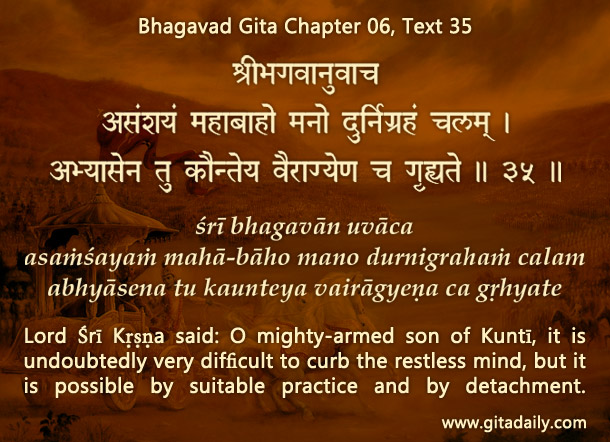
06.35 Lord Śrī Kṛṣṇa said: O mighty-armed son of Kuntī, it is undoubtedly very difficult to curb the restless mind, but it is possible by suitable practice and by detachment.
Leave A Comment