
The remark came from a tall, well-built, mustached Indian professional dressed in a suit and tie. He had apparently come directly from work to meet me in Seattle. He spoke those words enthusiastically, with a bright smile on his face.
I was taken aback. I wondered whether I had heard him correctly. That members of an audience sometimes fall asleep while hearing a class is an inevitable and unpleasant fact of life for every speaker. But no one had ever come to meet me and begun our conversation by pointing it out so directly—and so cheerfully.
Probably seeing the confusion on my face, he clarified, “I meant that as a compliment.”
He explained, “I was going through a lot of anxiety, and I was finding it increasingly difficult to sleep. I had started taking sleeping pills, and I needed more and more of them. I didn’t want to keep taking them, but I couldn’t sleep without them.
“Then I came across your series of seventy-five classes on the Mahabharata. They reminded me of my childhood. My grandmother would tell me these Mahabharata stories every night as bedtime stories, and I would fall asleep feeling loved and protected.”
As he spoke about those memories, a faraway look, both wistful and joyful, came into his eyes. After a brief pause, he continued:
“Hearing your Mahabharata classes reminded me of those childhood experiences and helped me feel similarly sheltered. I began to feel peaceful and could drift off to sleep naturally. Eventually, I was able to give up the sleeping pills completely.”
I felt relieved as the seeming criticism turned out to be a compliment.
The Shelter Behind the Appreciation
As a speaker, few things are as satisfying as knowing that what I speak is actually helping my audience. Over the years, I had received appreciation for how absorbing some of my retellings of the Mahabharata were and for how illuminating some of my examples and analyses were in clarifying difficult or controversial points. But this appreciation was different: this was the first time someone had told me that through my classes he had found shelter in Krishna. I found this particular appreciation especially satisfying.
I have found that such appreciation can also be a powerful source of motivation. When travel becomes difficult or speaking schedules become demanding and exhausting, knowing that my efforts are making a meaningful difference in someone’s life can give me strength to continue. I felt that this particular interaction would remain a significant source of motivation for me.
But then a more searching question struck me: Might I sometimes be seeking more shelter and strength in the appreciation I receive for speaking about Krishna’s stories than in Krishna’s stories themselves?
The question gave his compliment an entirely different significance.
Later, as I reflected on that interaction, I found myself thinking about context. As someone who spends much of my waking life immersed in wisdom—reading it, contemplating it and articulating it—one truth has struck me repeatedly: context is critical for understanding content. The same words can convey differing or even opposing meanings depending on their context. I had experienced that truth firsthand in a way that was dramatic and unforgettable.
As I continued to reflect on that incident, another context emerged—one that was far less humorous and much more serious.
Making Memory a Treasury
A theme I have spoken about frequently is that one purpose of bhakti is to make our memory into a treasury. This is one way I understand Krishna’s progression in Bhagavad Gita 8.5–7.
In 8.5, Krishna says that one who remembers him at the time of death attains him. But remembering Krishna at that final moment is not meant to be an isolated, one-time act. When we face great distress, our consciousness naturally gravitates toward wherever we have experienced shelter. If a violent storm is approaching, we instinctively seek the place we consider most secure. Similarly, when death—the ultimate crisis of our embodied existence—comes upon us, our consciousness will naturally seek whatever has become its deepest shelter.
Bhagavad Gita 8.6 explains that the state of consciousness we remember when leaving the body shapes our destination thereafter. That is why Krishna’s instruction in 8.7 is not merely to remember him at death. He tells Arjuna to remember him at all times while simultaneously performing his duties. We practice remembering Krishna throughout life so that remembrance of him increasingly becomes a place of shelter for our consciousness.
The purpose of hearing about Krishna, therefore, is not simply to perform the devotional activity of hearing. Through hearing, we are also forming memories of Krishna—memories to which our consciousness can return.
This point had once come out in a Hindi class of mine in an unexpectedly memorable way:
Yādein hī nahin hoṅgī, to yād kaise kareṅge?
If we don’t have memories, how will we remember?
I have tried to formulate the same thought in English, but something gets lost. Hindi uses the closely related yādein for memories and yād for remembering. English uses two distinct words, so the wordplay—and some of the force of the question—disappears.
Yet my conversation with this man revealed another distinction that I had perhaps not sufficiently considered. Having memories of Krishna and taking shelter in those memories are not necessarily the same thing.
I had studied the Mahabharata extensively. I had memorized many of its stories and could recollect their specific details quite accurately. I could draw upon those memories when I spoke or wrote, and my audiences could become absorbed in hearing them.
But how was I using those memories myself? Was I turning to them merely as resources for my outer life of speaking about Krishna, or also for nourishing my inner life of seeking shelter in Krishna?
When speaking about Krishna’s stories, was I sometimes becoming so caught up in the specifics of presentation that I neglected the substance of shelter? Was my memory functioning merely as an informational library, or was it also becoming a spiritual sanctuary?
One of my mentors had once told me, “What we speak is meant not only for others; it is meant for us too.” Contemplating on that instruction and this experience, I offered a prayer:
My dear Lord, may your sacred stories be present not just in my memory, but also in my inner life. May I turn to them not just so that I can render my service of speaking more effectively, but so that I can find solace and shelter in them more deeply. May the appreciation I receive for speaking about you never become more precious to me than attraction to you and absorption in you. May my memory become a treasury centered on you—on your sacred stories, your sublime statements and your supreme sweetness. And from that place of inner enrichment, may I help others become similarly enriched.
***
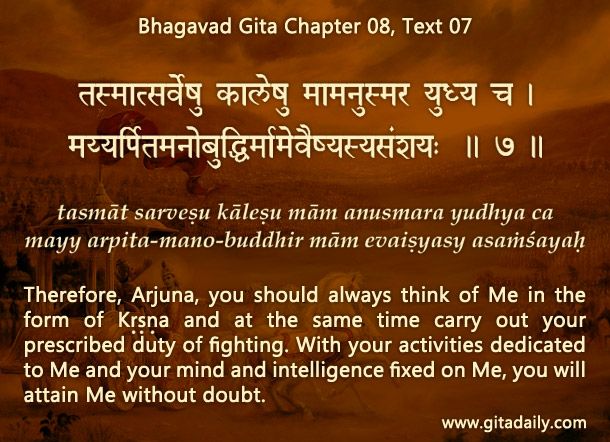
08.07 Therefore, Arjuna, you should always think of Me in the form of Kṛṣṇa and at the same time carry out your prescribed duty of fighting. With your activities dedicated to Me and your mind and intelligence fixed on Me, you will attain Me without doubt.
Leave A Comment