
This was the first question I received after my Srimad Bhagavatam class on 2.9.19 at ISKCON Toronto on September 12, 2026. It came from Bhaktimarga Swami, the sannyasi guru who is the leader of the community. With his trademark expressive gestures, he continued:
“Were both their hands vertical? Or were they horizontal, with the Lord’s hand above Brahma’s hand? Or was the Lord holding Brahma’s hand in both his hands and gently rubbing it?”
“I too have wondered about this,” I replied.
“The Sanskrit uses kare spṛśan — which has two essential words: ‘hand’ and ‘touching.’ Similar expressions occur elsewhere in scripture when the Lord touches someone with his hand, such as when Lord Narasimhadeva touches Prahlada on the head to bless him.
“Here, however, Srila Prabhupada extends the sense from touching with the hand to touching the hand with the hand—or shaking hands. As far as I know, neither Srila Prabhupada nor the previous acharyas have elaborated on the mechanics of the handshake.
“So what exactly is Prabhupada doing when he uses the word ‘handshake’ here?
“That brings us to a broader point about translation: What is translation meant to do?”
Translation of Words or Worlds?
“The purpose of translation can be understood in terms of two goals: getting it right and getting it across.
“Getting it right means conveying with linguistic precision what is stated in the original language into the language of translation. Getting it across means ensuring that readers understand not just what is being said, but also what is being implied.
“To understand the difference, consider an example.
“Suppose an ancient Chinese medical text contained a cure for cancer. A scholar fluent in Chinese and English might translate every sentence with great linguistic precision. But suppose another translator was a Chinese doctor who had studied that book and had successfully treated cancer patients for thirty years using the knowledge it contained. The doctor’s English might not be as polished as the linguistic scholar’s, but whose translation would we trust more when trying to understand and apply the treatment?
“The doctor’s translation. Why? Because our primary concern is not merely linguistic precision; it is transformative application.
While focusing primarily on Maharaj as I answered, I also looked around to see how interested the rest of the audience seemed to be. Seeing them listening attentively, I continued elaborating.
“Srila Prabhupada often does something similar. He does not merely translate words from one language into another; through his linguistic translations, he frequently performs what we could call conceptual and cultural translation. He communicates the world of scripture to readers living in a very different world.
“For example, in one of Prahlada Maharaja’s prayers, Prahlada describes the ears being attracted by tempting material sounds. Srila Prabhupada renders this in contemporary terms by referring to ears attracted to ‘radio songs.’ There were obviously no radios in Prahlada’s time, and there is nothing in the Sanskrit that points specifically to a radio.
“Prabhupada’s focus was not just on getting it right; it was also on getting it across. The timeless principle is that our ears can become captivated by distracting sounds. During Prabhupada’s time, radio songs provided an immediately recognizable example. Today, perhaps, the corresponding distraction would be our phones.”
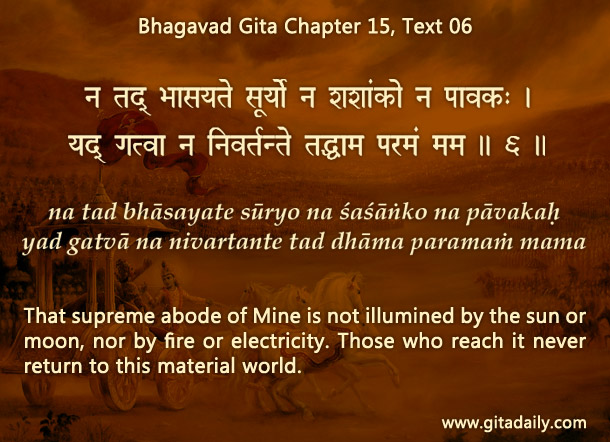
Srila Prabhupada does something similar in Bhagavad Gita 15.6. The Sanskrit states that Krishna’s supreme abode is not illuminated by the sun, moon, or fire. In his translation, Prabhupada adds electricity. The underlying point of the verse is that the spiritual world is self-luminous and requires no external source of illumination. As Prabhupada was writing for a modern audience for whom electricity was among the most familiar sources of illumination, adding electricity makes the point of the verse immediately relatable to his readers.
“Prabhupada thus helps us understand not only what scripture means, but what scripture means for us.”
In the class, I had explained the larger context of the Lord’s interaction with Brahma. In contemporary terms, it could almost be compared to a job interview. The head of a company may be interviewing someone he already knows and cares for. There may be affection between them and, if the interviewer is far senior, reverence from the candidate. Yet a serious responsibility is still under consideration. If the candidate is found worthy, such a formal interaction within an affectionate relationship might conclude with an appreciative handshake.
“The Lord here finds Brahma capable and therefore entrusts him with the immense responsibility of creating the universe. There is intimacy in their relationship, but there is also formality because of the seriousness of Brahma’s responsibility. Prabhupada’s rendering of the gesture as a handshake conveys both—the warmth of the relationship and the formality within that intimacy.
“So as far as the exact mechanics of the handshake are concerned, since neither the text nor Srila Prabhupada elaborates on any special form of handshake, I would understand it in the normal sense in which we use the word. Of course, when the hand being extended is the Lord’s hand, even a normal handshake becomes extraordinarily special.”
On hearing my answer, Maharaj nodded in acknowledgment, and I moved on to questions from others in the audience.
The Translation I Completely Missed
The devotee organizing my Toronto tour later told me that Maharaj’s question had been playful. After a serious class, he was trying to lighten the mood and, in his own warm way, welcome me.
I had missed that completely.
I felt first bemused, then amused, and smiled. Oh, that explains why Maharaj described three different kinds of handshakes so graphically.
I had taken a lighthearted question literally—and answered it seriously.
I realized that while I had been so thoroughly explaining one kind of translation, I had completely missed another kind of translation: translating the social and emotional context of the question itself.
Several people appreciated the answer, so perhaps something worthwhile came from my social cluelessness. But the incident reminded me of a principle I had learned during my early years as a speaker:
When answering a question, don’t listen only to the words that are spoken; listen also for the words that are not spoken.
That’s why I regularly rephrase or paraphrase a question before answering it. I want to ensure that I have understood the question and reassure the questioner that I have understood it.
But I realized that I had been doing this primarily at the intellectual level. I listened for the unspoken words to understand the meaning of the spoken words.
I needed to do the same at the emotional level. I needed to look beyond the words not just for the meaning, but also for the mood.
Such is the life of a traveling speaker. While I am teaching every day, I am also learning every day.
After reflecting on the incident, I prayed:
“My dear Lord, You shook Brahma’s hand to empower him to create. You used Maharaj’s question to teach me to become more emotionally attuned.
“O ever-guiding Lord, please never let me become so caught up in my identity as a teacher that I forget or neglect my deeper identity as a learner and a seeker. You reveal yourself to me both when I am teaching and when I am learning—perhaps even more through the latter than through the former. May I remain always ready to learn, so that through both teaching and learning I may keep coming closer to you.”
***
15.06 That supreme abode of Mine is not illumined by the sun or moon, nor by fire or electricity. Those who reach it never return to this material world.
Leave A Comment