
“This statement is philosophically misleading and potentially dehumanizing.”
I looked in shock at the statement that had popped up on my computer.
I had just completed an article entitled “Human Life Is Too Precious to Be Wasted in Being Human.” As I normally do after completing an article, I had asked AI to review it, primarily for grammatical issues and secondarily for any problems with logic, flow, or references.
But this was no review. As I read further, I found a scathing criticism attempting to dismantle the article point by point. Though I could see faults in its arguments, I was still jolted. Had I blundered so badly that my core idea came across as insensitive, even callous?
Then I scrolled back up to check my prompt and discovered what had happened. I had intended to type, “Review this article.” Somehow, while typing quickly and using autocomplete, “Review” had become “Refute.”
AI had simply done what I had asked.
Bemused by my mistake, I corrected the prompt: “Review this article.”
Now its response to the very same title was dramatically different: “This statement is electric, paradoxical, slightly shocking, but overall attention-grabbing.”
The contrast struck me. Whenever AI responds to my writings, one part of me evaluates what it has done, while another part evaluates what I would have done differently. After the first part of me had made sense of what had happened, the second part started marveling at how quickly AI had shifted from refute mode to review mode.
I too have operated sometimes in review mode and sometimes in refute mode. Over the last three decades, I have been asked to review writings by many devotees, be they seniors, equals, or juniors. And I have also been asked to refute articles, mostly by atheists or religious extremists.
Seeing AI’s quick shift from refute mode to review mode reminded me of an important truth: purpose shapes evaluation.
My thoughts went to how this truth is illustrated in Krishna’s approach to karma-kanda (the path of material religiosity) in the second chapter of the Bhagavad-gita.
Krishna wanted Arjuna to do his part in the divine plan by fighting. Initially, Krishna motivates him using the logic of karma-kanda (2.31–2.37). He concludes that section with a clear profit-loss analysis to show how fighting is a win-win option for Arjuna: if he fights and dies, he will attain heaven; if he fights and wins, he will enjoy an earthly kingdom (2.37).
But then, surprisingly, in the very next verse Krishna asks Arjuna to rise above calculations of happiness and distress, gain and loss, victory and defeat (2.38). Here Krishna is leading Arjuna toward a way of working that will provide him not gain in this world, where everything is temporary, but growth toward transcendence, where everything is everlasting.
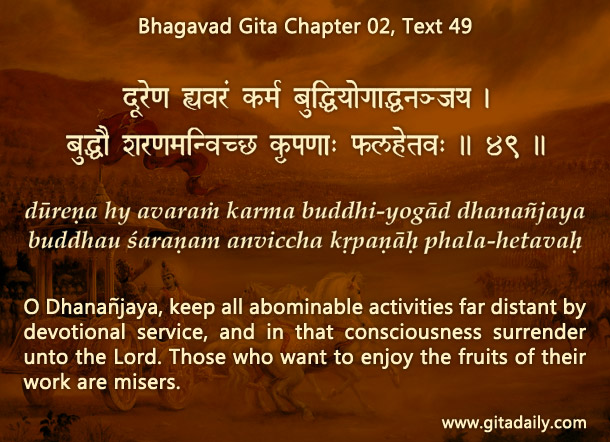
After explaining how transcendence can be attained through the practice of karma-yoga (2.39–2.48), Krishna changes his evaluation of that same karma-kanda framework—he rejects actions motivated by their fruits as small-minded compared with actions guided by spiritual intelligence (2.49).
My accidental switch from “review” to “refute” suddenly gave me an experiential window into Krishna’s approach. The same article could be reviewed or refuted depending on the purpose I gave AI. Similarly, the same karma-kanda framework could be recommended or rejected depending on the level at which Krishna was guiding Arjuna.
I found myself wondering: Was I rejecting as limiting something that could actually be useful? Was I considering as useful something that was actually limiting me?
Pondering such questions, I offered a prayer:
My dear Lord, please help me understand my purpose clearly—both the larger purpose of my life and my specific purpose in particular situations—so that I can appropriately evaluate whatever I encounter. Help me appreciate and utilize whatever is helpful, even if it might have been limiting for me in the past or might be limiting for others. And help me stay away from whatever is limiting for me, even if it might have been useful to me in the past or might be useful for others. Guide me ultimately to choose whatever brings me closer to You.
***
02.49 O Dhanañjaya, keep all abominable activities far distant by devotional service, and in that consciousness surrender unto the Lord. Those who want to enjoy the fruits of their work are misers.
Leave A Comment