
“I just can’t believe that I failed.”
A distraught student at the University of Toronto said this to me after my talk there on September 10, 2026. She explained that throughout her education in India, she had always been among the top students in her class. Failing an exam had been utterly unimaginable for her.
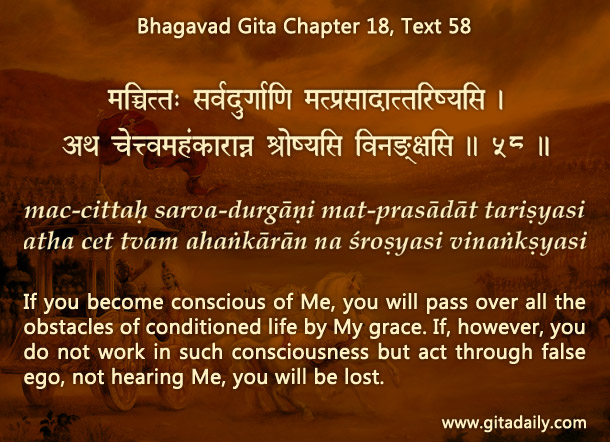
I tried to console her by reminding her: Failure is an event in our life story; it doesn’t have to become our life story. The story of our life is far bigger and better, and we can get a sense of that larger story when we connect with Krishna, who helps us cross over all obstacles by his divine grace, as explained in Bhagavad Gita 18.58.
After returning from the college program, something about that interaction stayed with me. The mixture of disbelief, dismay, and disgust in her expression seemed somehow familiar.
And then it came back to me—a memory I had almost forgotten.
I too had failed once.
My Academic Debacle
Throughout my student life, I had almost always been among the top students. But in the second semester of the second year of my Electronics and Telecommunication Engineering degree, I failed in Engineering Graphics.
I too had been devastated. How could I, a student who had always been among the toppers in my class, have failed?
With the advantage of hindsight and distance, I can now see that the failure, while unbelievable to me then, was not entirely unexpected.
Since childhood, I had been a bundle of striking strengths and glaring limitations: intellectually sharp but physically slow; conceptually astute but practically absent-minded; good at writing but pathetic at drawing; good at speaking but appalling at singing. To some extent, those characteristics continue even now.
Engineering Graphics happened to demand one of the abilities in which I was particularly deficient. Drawing had never come naturally to me. My butter fingers seemed especially adept at making mistakes when precise physical dimensions had to be translated onto paper.
As I thought back to those painful memories of struggling to draw during my engineering days, I couldn’t help but smile. I now draw regularly in my classes. Indeed, I insist that organizers provide a projection arrangement so that I can draw on my tablet while explaining concepts.
As I thought further about this irony, I realized that all drawing is not the same. What I do during my classes is drawing as an illustration of concepts. Because I love understanding and explaining concepts, such drawing—which I sometimes call conceptographic drawing—comes naturally and creatively to me. I never had any opportunity for this kind of drawing during my school days.
Drawing as art—trying to depict something beautiful or moving—was utterly beyond me; I stopped trying after my second or third class. Drawing as a craft, however, was precisely what Engineering Graphics expected from me: I had to draw according to precise physical measurements. I found that kind of drawing monotonous, burdensome, and exhausting—and I was no good at it.
So, in retrospect, my failure in Engineering Graphics was understandable.
But at the time, I was devastated.
Then the devastation faded, and I started feeling normal again surprisingly quickly.
And then I started feeling disturbed because I was not feeling disturbed.
From Debacle to Pinnacle and Beyond
Life soon took me to the opposite extreme.
In the first semester of my third year, I took the GRE and scored 2350 out of 2400 (on the old scale)—the highest score anyone from my college had achieved till then. Suddenly, I became something of a celebrity on campus.
This was the closest I had ever come to actualizing my childhood dream. I had always wanted not merely to be among the top students but to be right at the top—and, if possible, comfortably ahead of everyone else.
Naturally, I was elated.
But once again something unexpected happened.
The elation faded.
And this time I became disturbed that I was not as happy as I thought I should have been.
After failure, I had been disturbed that I wasn’t more disturbed.
After success, I was disturbed that I wasn’t more delighted.
Looking back, those two experiences began undermining for me the mythology that surrounds both failure and success.
A myth about failure is that it is the end of life: I have failed; therefore my life has lost its meaning, my path forward has disappeared, and everything is over.
There is a similar myth about success—that it too is the end of life, but in a different sense: all of life is a mountain I am climbing, and success means finally reaching the peak, planting my flag there, and declaring that I have arrived.
My experience at both extremes suggested otherwise.
My academic debacle and my academic pinnacle taught me the same lesson from opposite directions: both the dejection associated with failure and the elation associated with success had been hyped up in my imagination. The trough was not as deep as I had feared; the crest was not as high as I had imagined.
After both, life went on.
And I had to go on with life.
When the Gita Gave Language to My Experience
Little did I know then that those experiences were foreshadowing what I would later encounter in the Bhagavad Gita.
The Gita gave language to what my experience had already shown me. It helped me see that deep within me there is a reality beyond both the trough of failure and the crest of success. That reality has two dimensions: who I am and whose I am.
Who am I?
At my core, I am a spiritual being. The successes and failures that occur in my life may be real and consequential, yet neither defines me. Those who realize their spiritual essence neither run away from pain nor run after pleasure (2.56).
Whose am I?
I am Krishna’s, an eternal part of the Divine. Focusing on him and his purpose helps me stay steady amid life’s dualities (12.18–19).
Krishna’s benevolent purpose for my life is not simply to take me to some worldly peak of success. Nor does finding myself in a valley of failure mean that he has abandoned me. His benevolent purpose is far bigger than either success or failure, and it continues to operate through both.
From Duality to Divinity
As a traveling speaker, I encounter such dualities almost every day.
In some sessions, the audience is engaged and enlivened, sharing insightful personal reflections and asking intelligent questions. In other sessions, the audience stares at me as if they are watching a foreign-language movie without subtitles.
Some three decades ago, life went on after the debacle of Engineering Graphics, and life went on after the pinnacle of the GRE. Similarly, nowadays life goes on for me after every talk, whether the audience is vibrant or vacant.
The sheer pace of my travels probably helps. Every third or fourth day, I am often in a different city, preparing to speak to another audience. There simply isn’t much time to keep dwelling on either the successes or the failures of what has already happened.
Still, I hope that I am less affected by these dualities not because I don’t have time to reflect on them, or because I have become apathetic toward life, but because I am becoming more absorbed in something beyond life and its dualities.
Perhaps I have come closer to realizing that successes and failures are not the destinations of my life. They are just stations through which I pass during my life’s journey toward Krishna, who is my ultimate destination.
I pray:
“May the Lord, who dwells within me through all of life’s dualities, draw me through those very dualities toward his inexhaustible love that exists beyond all duality.”
***
18.58 If you become conscious of Me, you will pass over all the obstacles of conditioned life by My grace. If, however, you do not work in such consciousness but act through false ego, not hearing Me, you will be lost.
Leave A Comment