
“You are so analytical and intellectual. You should have been an IIT graduate. Had you applied for JEE?”
This was the question asked by a dean at one of the IITs where I had given a talk on Indian knowledge systems. We were sitting together after the talk in his office. He sat behind an expansive mahogany desk. Framed certificates hung on the wall behind him; to his right, a display case gleamed with trophies.
His remark was a familiar blend—part compliment, part question, part implicit critique. I felt a mild weariness settle over me; I had heard variations of it for years.
“I wasn’t able to clear the JEE,” I replied quietly. “My home life went through a sudden upheaval around that time.
“My mother passed away from leukemia within a single month of her diagnosis, just after my tenth-standard results. Because my father had a job that required constant travel, my mother had been my emotional anchor. Her abrupt absence left me disoriented, even devastated. With my four-year-old brother to care for in Nashik, my focus was fractured.”
The dean listened quietly as I explained. I felt as if a flicker of understanding crossed his eyes, accompanied by a polite hint of sympathy. As I spoke, his expression of sympathy triggered a vivid memory—not of exam halls or textbooks, but of the heavy, uncomfortable silence that would descend on our house in the afternoons. While my little brother was outside playing with neighbors, I would sit at my desk trying to concentrate on physics formulas, half-expecting my mother to walk into the room with water or some refreshing drink, asking how my study was going. Then the stillness would remind me: no one was coming.
Later, as I pondered the dean’s question during my next flight, I wondered whether that grief was the complete story. Despite the disruption, I had managed to perform well enough in my twelfth-standard exams to secure admission into the College of Engineering Pune—an elite institution, even if regarded as a rung or two below the IITs.
If my family circumstances were not the sole reason, was something larger at play?
Saved from Intellectual Pride?
That question nudged open the door to a conversation I had almost forgotten.
Some fifteen years earlier, a senior monk who was himself an IIT graduate had heard a Bhagavatam class I gave. Afterward, he asked about my educational background. When he learned that I had never attended an IIT, he offered a startling observation:
“I think Krishna saved you from IIT so that you could come to Him.”
At the time, I took it as a warm, striking sentiment—emotionally resonant, but not something to dissect philosophically.
I felt prompted to examine his remark more analytically now because, for the last year or so, I had repeatedly been speaking about how God’s plan may be working in our lives even when we cannot see its workings. What exactly had he meant when he said Krishna had “saved” me from IIT? I tried to recall his reasoning.
His point, as I understood it, was not that IIT itself would have been an obstacle to spiritual growth—after all, he himself was an IIT graduate and a monk. Rather, given how strongly I then equated intellectual achievement with self-worth, that particular success might have reinforced something within me that I first needed to outgrow: my overidentification with my intellect.
The Bhagavad Gita repeatedly warns how ahaṅkāra—false ego and conceit—can become a formidable inner obstacle, turning the mind away from God. Perhaps an elite academic badge, coupled with my intellectual strengths, might have further inflated my pride, making spirituality seem unappealing or simply unnecessary.
What Happened to Me—and What Happened for Me
As I contemplated this point, my mind went to the Ramayana, which I had recently been rereading to research stories for my book on relationships, and more precisely, to the story of Sugriva.
Because of a tragic misunderstanding, Sugriva was hunted relentlessly by his formidable brother Vali. Desperate and terrified, Sugriva fled across the subcontinent, traversing many mountains, crossing many unfamiliar rivers, and journeying through distant territories before finally discovering sanctuary at Mount Rishyamukha, where Vali could not set foot because of a sage’s curse.
At the time, Sugriva could have viewed his prolonged, perilous wandering as sheer torment. He could have felt especially frustrated on eventually discovering that his sanctuary was so close to what had previously been his home, after he had searched for safety across such vast distances. He could well have thought, “Why didn’t I think of this place before?” All that wandering could have seemed not only painful but also pointless.
Yet years later, when Lord Rama sought his assistance in finding Sita, those wanderings acquired an unexpected significance. When dispatching search parties across the four directions, Sugriva provided a remarkably detailed geographical survey of distant realms, rivers, mountains, and terrains. The very wanderings that had once seemed only an ordeal had equipped him with knowledge that could now be used in Rama’s service.
What Sugriva had endured as an ordeal inflicted upon him had unexpectedly prepared him for an extraordinary service to Rama.
Reflecting on that narrative, I saw a possible parallel in my own path.
Missing IIT had not extinguished my ambition; if anything, it made me hungrier to prove myself. I poured that intensity into preparing for the GRE, eventually securing the highest score in the entire state of Maharashtra.
Yet when that crowning academic validation finally arrived, it brought a surprising, hollow anti-climax. The external recognition I had pursued so fiercely did not yield the inner fulfillment I had assumed would accompany it. That very disillusionment opened an unexpected door: it prompted me to look inward for meaning and lasting joy rather than continuing to chase external stamps of approval.
Had I gone to IIT, would that bubble of worldly accomplishment have burst so early? I could not know for sure.
And that uncertainty made me pause.
Seeing God’s Hand—Imagination or Inference?
Was I slipping into a kind of facile providentialism—conveniently attributing to divine arrangement whatever had happened in my life and then constructing a spiritual explanation for it afterward?
I felt that I needed to distinguish three things: What I know. What I cannot know. What I can explore based on what I know.
What I know: I did not get into IIT. I subsequently pursued academic achievement intensely and eventually attained a significant measure of it, only to discover that it did not provide the fulfillment I had expected. That disillusionment became one of the factors that turned my search inward and eventually toward Krishna.
What I cannot know: I cannot know whether Krishna literally blocked my path to IIT. I cannot look behind the workings of providence and claim certainty about why a particular door in my life closed.
What I can explore based on what I know: After that door closed, what doors opened? What did that disappointment expose within me? What did my subsequent pursuit of achievement teach me? And how did that entire sequence shape the direction my life eventually took?
Seeking answers to these questions does not give me certainty about the hidden workings of providence. But it does give me reasonable grounds to consider that what initially seemed a deprivation might have been a preparation for something better.
That inference brought to mind a truth the Bhagavad Gita gives me more directly. Krishna describes Himself as suhṛdaṁ sarva-bhūtānām—the intimate, ever-present well-wisher of all living beings (5.29). Knowing Him as such is the foundation of genuine peace.
My experience cannot tell me exactly how His benevolence was working in a particular event. But scripture gives me reason to remain receptive to the possibility that His benevolence may be working even when I cannot yet discern how.
When we are saved from an obvious difficulty, gratitude comes naturally: Krishna saved me. Divine benevolence is relatively easy to recognize when it appears as protection from difficulty. But sometimes that benevolence may become visible only much later as preparation through difficulty.
Sugriva was not spared his terrifying flight from Vali. Yet that very flight equipped him for a service he could not then have foreseen.
Perhaps something similar had happened in my life. I cannot know whether Krishna saved me from IIT. But I can see how not going there became part of a sequence of experiences that prepared me for a different search—a search that eventually brought me toward Him.
That is an inference I can make not by pretending to know the hidden workings of providence, but by looking honestly at the trajectory of my own life.
As I dwelt on that inference, I offered a prayer:
“My dear Lord, even when something good that I had hoped and tried and even prayed for does not happen, may the closing of that door never close my heart to Your benevolence or my mind to the possibilities You may open. Whatever else I lose in my life journey, may I never lose faith in You or openness to see how You may transform what happened to me into what happened for me.”
***
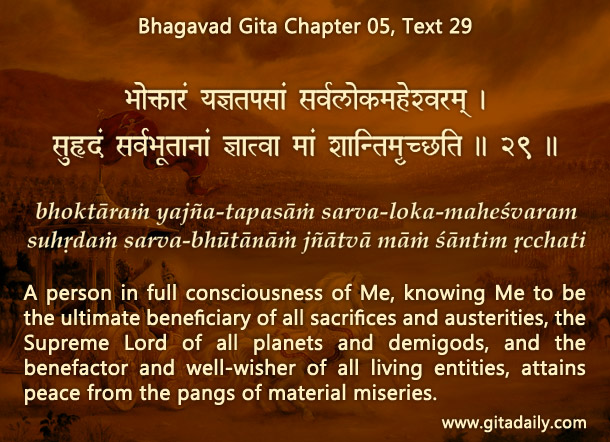
05.29 A person in full consciousness of Me, knowing Me to be the ultimate beneficiary of all sacrifices and austerities, the Supreme Lord of all planets and demigods, and the benefactor and well-wisher of all living entities, attains peace from the pangs of material miseries.
Leave A Comment