
The distinction here is between validity and fidelity. Something can be accepted as valid without being the particular practice to which we commit ourselves when we join a particular tradition.
We see this principle even outside religion. Two reputable schools may recognize each other’s education and qualifications as valid. Yet a student who transfers from one to the other follows the curriculum, discipline, and uniform of the school they have now joined. Accepting the first school as valid does not make the practices of the two schools interchangeable.
The same principle appears in Christianity. The Catholic Church and several Reformed churches have formally recognized one another’s baptisms as valid under specified conditions. Yet Catholics and Reformed Christians retain their own requirements for membership and religious practice. Thus, recognizing another tradition’s baptism as valid does not eliminate the specific commitments involved in belonging to one’s own tradition.
Within Vaiṣṇavism, we see something similar in the Vaḍakalai and Teṅkalai branches of Śrī Vaiṣṇavism. Both have their distinctive forms of ūrdhva-puṇḍra and other lineage-specific practices. Yet samāśrayaṇa, or initiation, into one particular branch requires followers to adopt the practices of that branch.
This brings us to the Gauḍīya tradition. Śrīla Prabhupāda’s stated that both the Rāma-first and Kṛṣṇa-first sequence could be chanted. Yet he consistently gave his disciples the Kṛṣṇa-first mahā-mantra and required them to chant sixteen rounds in that form.
The stature of Murāri Gupta illustrates the same principle within the Gaudiya tradition. He was a senior and intimate associate of Mahāprabhu, and Mahāprabhu glorified his unwavering devotion to Lord Rāma. Yet we do not find an enduring initiation parivāra descending from Murāri Gupta comparable to the Nityānanda-parivāra, Advaita-parivāra, and other Gauḍīya disciplic lineages. Rāma devotion could thus be wholeheartedly honored without becoming the devotional current transmitted through the Gauḍīya initiation lineages.
That’s why anyone taking initiation in the Gaudiya tradition will need to chant the Krishna-first version of the mantra. That does not mean we claim this version is intrinsically more powerful. The holy name has intrinsic spiritual potency, but our access to that potency comes through grace; for us, that grace comes through the blessings of Mahāprabhu and the ācāryas. The Kṛṣṇa-first sequence is the form they have transmitted to us, and therefore it is the form we chant and propagate.
To conclude, we can appreciate someone who has been chanting the Rāma-first sequence. Yet if they wish to receive initiation in the Gauḍīya tradition, they would need to adopt the Kṛṣṇa-first sequence for their chanting practice.
***
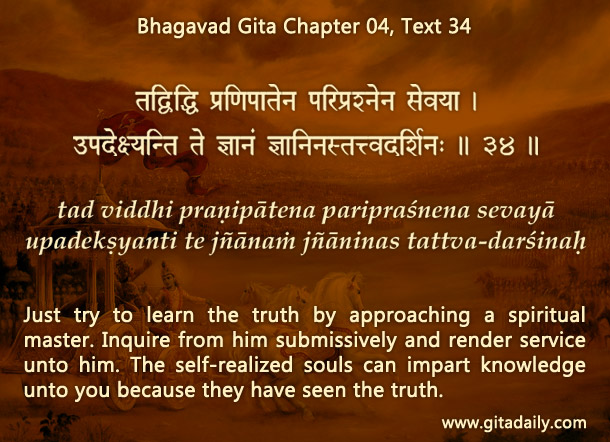
04.34 Just try to learn the truth by approaching a spiritual master. Inquire from him submissively and render service unto him. The self-realized souls can impart knowledge unto you because they have seen the truth.
Leave A Comment