
A student who had completed my self-paced online Bhakti Shastri course once came to meet me at Govardhan Eco Village. He had heard all 162 prerecorded classes, each around an hour long, but we had never interacted much personally.
During our conversation, I made a slightly humorous point and laughed at it.
He looked surprised.
“I didn’t know that you even laughed.”
I was taken aback. “What do you mean?”
“You never once laughed during all those recordings,” he said. “I thought you were an extremely serious person who never laughed.”
He was completely earnest.
I didn’t know whether to laugh or cry at his comment—not cry literally, but in the sense of feeling exasperated. I didn’t quite know what to do with what he had said.
I had been somewhat aware that people perceived my talks as highly intellectual. But his comment made me realize that there was another issue I had hardly noticed: I could come across as remarkably non-humorous.
A Serious Lack of Humor
As a traveling speaker, I have often found that my reputation precedes me. During the first decade of my outreach, I focused largely on science and spirituality. I was mostly speaking to youth and addressing difficult questions, many of them centered on the interface between science and spirituality. That subject had fascinated me when I was introduced to bhakti during my engineering days, and my interest had naturally evolved into a service.
Even when speaking to devotees, my presentations tended to be more analytical and rational than those of many other speakers. Over the years, several people told me that although I arrived at devotional conclusions, I generally addressed the heart through the head. Sometimes, by the time my rigorous analysis at the level of the head was over, they were too exhausted for the conclusions to reach the heart.
I knew I needed a healthier balance between head and heart. What I hadn’t realized was that, apart from being intellectual, I could also come across as unusually grave and non-humorous.
When I asked some fellow speakers, guides, and regular students, they confirmed it.
One student described attending my classes as “an intellectual workout.”
Another student, who was not particularly intellectually inclined, put it more graphically: “When I hear your classes, dimāg se dhuā̃ ātā hai”—smoke comes out of my head, a typically Hindi way of saying that the brain gets heavily overworked.
One of my monk friends used memorable wordplay to convey the point: “Normally, when a class is to be given, the speaker has to prepare for the class. When you give a class, the audience has to prepare for the class.”
What struck me about these comments was that I had never really noticed the absence of humor in my classes. When attending the classes of other speakers, I had certainly noticed how much audiences appreciated humor. Personally, however, I often found the humor somewhat distracting from the substance of the class.
For much of my life, I had more or less equated humor with a lack of seriousness.
That assumption was challenged when I worked closely with a senior monk known for being exceptionally humorous. Observing him over several quarters, I came to appreciate that his humorous speech did not detract in the least from his seriousness about his spiritual life and service. His example helped dismantle my assumption that humor and seriousness were somehow incompatible.
I then began looking back at my own life to understand where my lack of humor might have come from. Neither my parents nor my grandparents were particularly humorous, nor do I remember any of my teachers in school or college being humorous. But it wasn’t only that humor was largely absent from my environment; I wasn’t particularly attracted to environments where humor was prominent. I rarely watched comedy shows on television or sought out stand-up comedy. Humor simply wasn’t something I naturally gravitated toward.
But although the lack of humor had never seemed particularly significant in my life, I now realized that its absence could significantly affect my life as a speaker.
People sometimes perceived me as formal and unapproachable. Earlier, only the most intellectual—and perhaps the most intrepid—among the audience would approach me with questions after a class. When I started taking my books to programs and people began coming to get them signed, those interactions created a natural bridge, and some people who might otherwise have hesitated started approaching me.
But I began to wonder whether the problem went further. If people found me unapproachable personally, might some also find my classes unapproachable? They might not only hesitate to approach me after a talk; they might hesitate to approach the talk itself—whether by attending it in person or listening to a recorded talk online.
So there was something I needed to change.
Trying to Engineer Humor
One of my guides told me that humor is among the best ways to keep people awake and alert during a class. He even suggested the specific wording I could put on a small physical note beside my laptop trackpad, where only I could see it: “Even the best class is no good if the audience is asleep.”
I tried it for a few talks. But instead of helping, the note became annoying and distracting. Glancing at it disrupted my thought flow, and whenever several slides passed without anything humorous, the reminder almost seemed to be accusing me.
I tried consciously to become more humorous. But as one regular listener observed, even my humor tended to be intellectual. I naturally enjoyed phrasing ideas through wordplay, sometimes in ways that turned out to be witty. But when I consciously tried to make something funny, it often felt artificial.
After one such failed attempt at humor, I was journaling about what had happened when the irony of the whole exercise struck me. Here I was, a former engineer trying to use an engineering technique to engineer humor.
It was a lot of work. Worse still, it wasn’t even working.
So I started observing other speakers more carefully. I noticed enormous differences. Some were serious both in their one-to-one interactions and in their talks. Some were serious one-to-one but wonderfully humorous from the podium. Others were humorous both personally and publicly. And some who were quite humorous in personal conversation became serious when speaking publicly.
I also talked with some speakers who were known for being humorous, either in their classes or both in their classes and personal interactions. Many told me that humor had always been a part of their lives. Very few described it as something they had consciously learned.
That raised a larger question for me: How much of who we are can—and should—we try to change?
What Can Repression Accomplish?
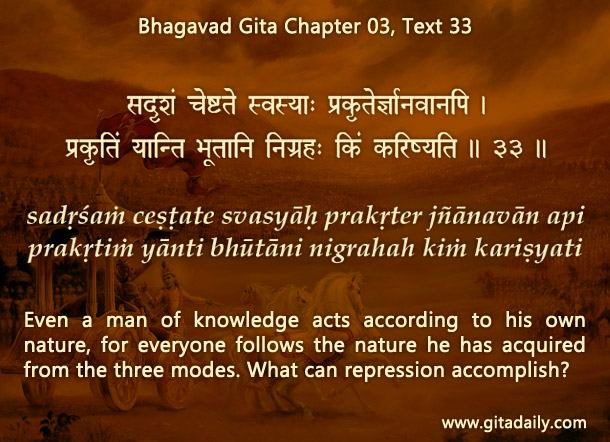
Bhagavad Gita 3.33 states that even a person of knowledge acts according to their own nature and asks, nigrahaḥ kiṁ kariṣyati—what will repression accomplish?
Certainly, the Gita doesn’t teach that our nature is our destiny. If I am impulsive, I can learn to go beyond my impulses. If I am short-tempered or susceptible to jealousy or craving, I can work to outgrow those tendencies. Indeed, the possibility of human reformation and redemption is one of the most hope-giving and life-affirming aspects of the Gita.
But not everything about our nature seems equally malleable.
Some things may change with reasonable effort. Some may change only with enormous effort. And some may remain deeply rooted despite sustained effort. Discernment means not merely asking, “Can I change?” but also, “Which changes are worth pursuing, and at what cost?”
I began to see another dimension to the Gita’s question: What can repression accomplish?
Repression can work in two directions. I can forcibly keep inside something that naturally wants to come out. But I can also try to forcibly bring out something that isn’t naturally there.
Neither works particularly well.
Choosing My Battles
Still, I couldn’t simply use “That’s my nature” as an excuse. My style had genuine limitations. If people found me unapproachable, or if my analysis exhausted their heads before my conclusions could reach their hearts, something needed to change.
For a long time, I had implicitly framed the choice as: either I learn to become more humorous, or I remain too grave.
Gradually, I realized there was a third possibility.
I could become warmer without trying to become funnier.
I know speakers who are not particularly humorous and yet are widely respected, appreciated, and loved. Humor is undoubtedly a powerful tool for communication, but it is not the only pathway from one heart to another.
I still appreciate speakers who can make people laugh while making them think. Humor can enliven a presentation in ways that warmth alone may not. I am happy when humor arises naturally in my speaking; I have simply stopped trying to manufacture it.
So humor is a battle I have chosen not to prioritize.
That doesn’t mean I have declared a moratorium on humor. As a speaker constantly trying to improve both my content and my presentation, I am always looking for memorable ways to formulate spiritual truths. If a humorous formulation arises naturally, I am happy to use it. What I have stopped doing is going out of my way to search for humor in life or taking a detour in a talk merely to insert something funny.
One important part of that effort is precisely what I am doing in writing articles like this one. Through these personal stories, I hope to increase the human and humane dimensions of my contemplation—and, naturally, of my presentation.
By human, I mean sharing my experiences as a human being who faces many of the same challenges that everyone else faces. By humane, I mean sharing those moments when something or someone touched my heart—or when I was somehow able to touch someone else’s heart.
These stories allow me to bring more heart into my speaking in a way that feels natural to me. They help me reflect on what my experiences reveal about me, about human nature, and about Krishna’s presence in our lives. Increasingly, I am sharing such stories in my talks.
Perhaps growth does not always mean becoming what we are not. Sometimes it means discovering a better way to express what is already deepest within us.
Changing ourselves is difficult, and we each have to discern which changes are both necessary and realistically achievable. For me, bringing more heart into my talks seems more fruitful than trying to manufacture humor. It can bring me closer to my audience without taking me farther away from myself.
Arriving at this understanding, I offered a prayer:
My dear Lord, please help me discern the balance between accepting the nature I have acquired and fulfilling the service You have given me.
Give me the strength to fight the battles You want me to fight, the humility to accept my limitations, and the grace to keep serving You wholeheartedly within them.
***
03.33 Even a man of knowledge acts according to his own nature, for everyone follows the nature he has acquired from the three modes. What can repression accomplish?
Leave A Comment