
I was asked this question after a recent class by a young man. He explained, “I’ve resolved to read the Bhagavad Gita daily for at least half an hour, preferably an hour. But often, it becomes like a ritual. I read simply because I’ve resolved to read. I don’t feel as if I’m learning much from my reading, or even actively engaging with the text.”
I replied, “I’ve reflected on this question many times during my three decades as a student of the Bhagavad Gita. And I’ve found some helpful direction within the Gita itself. In Bhagavad Gita 6.5, Krishna urges us to elevate ourselves through ourselves. I see this as an encouragement to cultivate an inner dialogue—a conversation between our higher self and our lower self.
“Our higher self is the part of us that is more spiritually oriented and connected, whereas our lower self is more attracted to and involved in the material side of life. By encouraging a conversation between these two sides of ourselves, we can make our spiritual practices more meaningful.”
He looked puzzled. “But how does that apply to active reading?”
I explained, “I often try to formulate acronyms to help me remember ideas. For active reading, I use a three-stage process called ARC: Articulate, Reflect, and Crystallize.
“The first stage is Articulate. Suppose I’m reading for half an hour or an hour. After fifteen or twenty minutes, or perhaps half an hour, I take a break and try to articulate what I’ve read in my own words, as if my higher self were explaining it to my lower self.
“I don’t try to repeat everything I’ve read. I focus on one or two key points, or at most three. Sometimes I speak them aloud. Sometimes I use transcription software so that I can see what I’ve articulated.
“The second stage is Reflect. Now I allow my lower self to respond. What questions, doubts, concerns, objections, or reservations might arise about what I’ve just articulated? I try to bring those questions into the conversation and think them through.
“Sometimes there may be just one question. Sometimes there may be several. And sometimes there may be none. The idea is not to manufacture questions but to give myself an opportunity to examine what I’ve understood.
“The third stage is Crystallize. Through this inner discussion, I try to crystallize my understanding into short, memorable phrases or sentences.
“Of course, I can’t always come up with a quotable sentence. But even when I don’t, I find that the process helps me arrive at a clearer understanding of what I’ve read.”
He asked, “Don’t people think it’s strange that you’re talking to yourself?”
I replied, “Yes. That’s why I generally do it in private. I also don’t want to disturb anyone else in what they’re doing.
“But talking to ourselves need not be strange. I remember reading in a biography of Bhaktivinoda Thakur that he would pace around and discuss different perspectives on an issue with himself while preparing his talks or writings. Such inner conversations can help us examine an idea from different angles.”
He said, “This sounds quite promising. I’ll try it out. Thank you.”
The Inner Conversations That Shape My Writing
After he departed, as I reflected on our discussion, it struck me how this kind of inner conversation happened not just when I read the Bhagavad Gita but also when I was writing, although in writing it often happened less consciously and less distinctly in stages.
I may have just written a sentence when I sense that something about it isn’t quite right. I then try to figure out what the problem is. Is there something wrong with what I’m trying to say, or have I simply not found the right way to say it?
As I consider whether the idea itself is unsound or the wording is unclear, an inner dialogue unfolds. One part of me proposes a formulation; another part evaluates it. Through that exchange, I gradually move toward greater precision both in the idea and in its articulation.
Thinking thus, I offered a prayer:
My dear Lord, just as You had a conversation with Arjuna thousands of years ago, please bless me so that I too may cultivate an inner conversation between my higher self, which seeks to be closer to You, the highest reality, and my lower self, which is often more drawn toward the material world and can become confused or distracted. Just as Arjuna moved beyond his confusion on the battlefield of Kurukshetra through his conversation with You, may my inner conversations, guided by Your words, help me grow in clarity, conviction, and confidence.
***
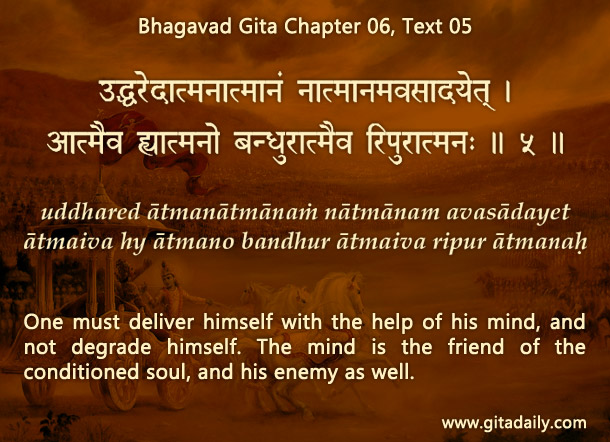
06.05 One must deliver himself with the help of his mind, and not degrade himself. The mind is the friend of the conditioned soul, and his enemy as well.
Leave A Comment