
To address this question, let us break it into four parts:
1. What does scripture say?
2. Did Mahāprabhu deliberately reverse the sequence?
3. What does the presence of different sequences imply?
4. Why do Gauḍīyas chant with Hare Kṛṣṇa first?
1. What does scripture say?
The Kali-saṇṭāraṇa Upaniṣad, associated with the Kṛṣṇa Yajur Veda, gives the sixteen names as the means for crossing over the influence of Kali-yuga. The widely available 1914 translation by K. Narayanasvami Aiyar gives the sequence with Hare Rāma first and Hare Kṛṣṇa second.
However, the textual tradition is not completely uniform. A Navadvīpa textual reading with Hare Kṛṣṇa first has also been reported and is discussed by Satyaraj Dasa (Steven J. Rosen). Thus, it is safer to acknowledge the existence of different textual traditions rather than insist that only one sequence has scriptural standing.
More importantly for Gauḍīyas, the Kṛṣṇa-first sequence is explicitly attested in the Caitanya-bhāgavata. In Madhya-khaṇḍa 23.75–78, Mahāprabhu instructs people to chant the mahā-mantra with Kṛṣṇa first and tells them to chant it constantly. Thus, quite apart from debates about different manuscripts of the Kali-saṇṭāraṇa Upaniṣad, the Kṛṣṇa-first sequence is firmly established within the early Gauḍīya tradition.
2. Did Mahāprabhu deliberately reverse the sequence?
This is certainly possible as a theological explanation. God is, after all, the source of scripture; and because Gauḍīya Vaiṣṇavas accept Mahāprabhu as God, we accept that he has the authority to adapt particular scriptural prescriptions according to time, place and circumstance.
But to acknowledge that something is possible is not to establish that it actually happened.
To claim historically that Mahāprabhu encountered a Rāma-first sequence and deliberately reversed it, we would need an early biography or another authoritative source stating that he made such a change and preferably explaining why. As far as we know, no such early evidence exists.
Indeed, although the early biographies describe Mahāprabhu teaching and chanting the Kṛṣṇa-first sequence, they do not report anyone questioning him about the sequence or any controversy surrounding it. Silence cannot establish exactly how widespread each sequence was, but it does suggest that Mahāprabhu’s use of the Kṛṣṇa-first sequence was sufficiently uncontroversial that his early biographers felt no need to explain or defend it. What was apparently uncontroversial for them need not become unnecessarily controversial for us.
There are later Gauḍīya explanations suggesting that Mahāprabhu deliberately placed Kṛṣṇa first. One such explanation is associated with Niṣkiñcana Kṛṣṇadāsa Bābājī Mahārāja, a disciple of Bhaktisiddhānta Sarasvatī Ṭhākura renowned for his extraordinary absorption in nāma-bhajana. But he gives no early textual basis for this particular explanation, nor did Śrīla Prabhupāda endorse it. We therefore need not regard it as necessary for understanding the issue.
More importantly, we do not need such an explanation to account for the existence of the two sequences.
3. What does the presence of different sequences imply?
Śrīla Prabhupāda addressed precisely this issue in a Śrīmad-Bhāgavatam lecture in Bombay on December 12, 1974. Speaking about whether Hare Rāma or Hare Kṛṣṇa should come first, he said:
«“Either you chant Hare Rāma or you chant Hare Kṛṣṇa, it is the same. There is no difference.”»
He then indicated that controversy over which should come first was “not very important.”
He made essentially the same point in another Bombay Bhāgavatam lecture on January 12, 1975: one may begin with Hare Kṛṣṇa or Hare Rāma; the essential point is the chanting of the divine names.
This diversity should not surprise us. The broader Hindu tradition, including its bhakti traditions, has always contained considerable textual, liturgical and regional diversity. Why one version of a mantra, teaching or practice becomes historically more widespread can depend on geography, manuscript transmission, influential teachers, sampradāyas and numerous other circumstances. Sometimes the precise reasons are no longer recoverable.
Popularity alone does not settle the question of authenticity.
The existence of the two sequences may therefore reflect historical contingencies whose causes are now uncertain or even unknowable, rather than any necessary difference in spiritual potency.
There is also a deeper theological consideration. Śrīmad-Bhāgavatam 6.2.14 teaches that even when the Lord’s name is uttered indirectly, jokingly, casually or neglectfully, it possesses extraordinary spiritual efficacy. If even such imperfect circumstances of utterance do not deprive the divine name of its potency, there is little reason to regard the same sixteen divine names as becoming questionable, let alone ineffective, simply because Kṛṣṇa and Rāma occur in a different sequence.
4. Why, then, do Gauḍīyas chant Hare Kṛṣṇa first?
Because spiritual practice is not merely about determining which forms may theoretically be valid. The Hindu tradition has always emphasized receiving mantra through guru and paramparā. A mantra is not simply a sequence of Sanskrit syllables circulating in a book; it is received as a spiritual practice through a living tradition.
Gauḍīyas have received the mahā-mantra with Hare Kṛṣṇa first. The Caitanya-bhāgavata associates this sequence directly with Mahāprabhu’s teaching, and subsequent Gauḍīya ācāryas have transmitted it in this form. For Gauḍīyas, therefore, the Kṛṣṇa-first sequence carries not only the intrinsic potency of the divine names but also the blessings of Mahāprabhu and the ācāryas through whom those names have been received.
That is why Gauḍīyas chant this sequence and propagate this sequence.
We don’t have to establish—or even debate—that the Rāma-first form is wrong in order to establish why the Kṛṣṇa-first form is right for us.
***
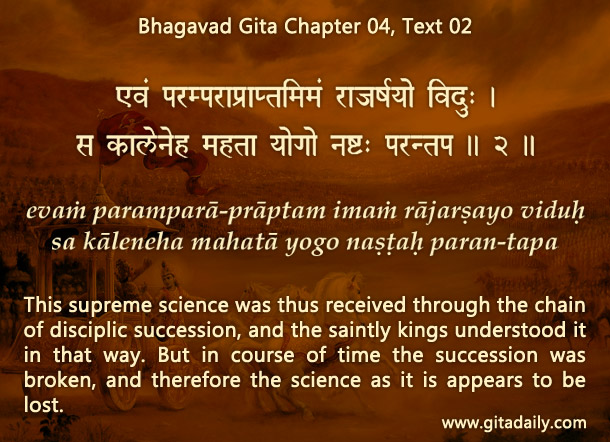
04.02 This supreme science was thus received through the chain of disciplic succession, and the saintly kings understood it in that way. But in course of time the succession was broken, and therefore the science as it is appears to be lost.
Leave A Comment