
A common assumption in modern science is that the physical brain generates consciousness. However, scientific evidence regarding near-death experiences (NDEs) poses a significant challenge to this idea, suggesting instead that consciousness exists separately from the body.
There are well-documented cases where people, after being declared clinically dead, report having vivid experiences entirely outside their physical bodies. In one striking case, a woman underwent a surgical procedure where her blood circulation was completely stopped and she was clinically dead. Yet, she later reported seeing herself lying on the operating table, observing the scene from above.
She accurately recalled wondering why her hair had been cut in a specific way. She noticed that while she was supposed to be undergoing brain surgery, the doctors were actually working on her thigh area to prepare for a bypass. She even accurately recalled the specific conversations between the medical staff during the procedure. Biologically speaking, it is impossible for an unconscious, clinically dead brain to process and record these sensory details.
Furthermore, there are documented cases of people who were completely blind in their physical lives, yet reported being able to see for the very first time during an out-of-body NDE.
The most reasonable explanation for these phenomena aligns with the teachings of the Bhagavad Gita: the source of consciousness is the eternal soul, not the brain. The brain may act as a transmitter for consciousness rather than its generator. Normally, the soul’s consciousness is routed through the physical body and limited by the body’s senses. But during traumatic events, the soul and body may temporarily separate. When the soul exits the body, it is no longer impacted or restricted by physical or sensory damage, allowing consciousness to continue independently of the physical form.
***
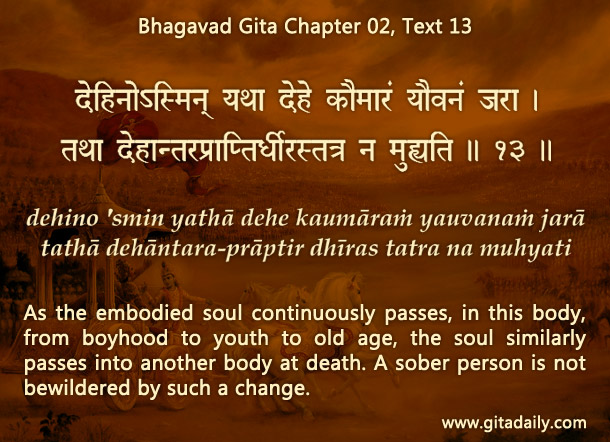
02.13 As the embodied soul continuously passes, in this body, from boyhood to youth to old age, the soul similarly passes into another body at death. A sober person is not bewildered by such a change.
Leave A Comment