
“Can Religion Help Us Overcome Religious Extremism?”
During my visit to Leicester, I went for a walk in Abbey Park, a large park with beautiful greenery, trees, and the River Soar flowing through it. As I walked, watching the birds and chanting my mantras, I felt peaceful, even serene.
Within the park were the ruins of Leicester Abbey, once one of the largest and wealthiest Augustinian monasteries in England. As I entered the abbey grounds, my mood gradually changed from serene to somber.
What remained of the once-magnificent abbey was largely a series of low stone walls, outlining where its buildings had once stood. Nearby, an illustration showed what the abbey had looked like in its glory. The contrast was striking: what had once been so majestic was now almost entirely absent.
The abbey church alone had stretched over a hundred meters. I contemplated how much effort it must have taken to build such an enormous structure nearly a thousand years ago, without modern construction machinery. And then I wondered how much effort it must have taken to dismantle it, without the explosives and demolition equipment available today.
The sheer scale of both the construction and the destruction unsettled me. A chill seemed to pass through me—not because the temperature had suddenly dropped, but because my mind was contemplating the cold, harsh reality of humanity’s inhumanity.
A devotee accompanying me had shared something about the abbey’s history. Our conversation, along with a quick online search afterward, refreshed my memory of what I had earlier read about European history.
The abbey had been founded in the twelfth century and had flourished for nearly four hundred years. Then, during the reign of Henry VIII, England broke with the authority of the Catholic pope. In 1538, the abbey was dissolved as part of the Dissolution of the Monasteries. Its religious community was disbanded, its property confiscated, and its buildings were eventually dismantled, with stones and other materials taken away for use elsewhere.
What struck me was that all this had happened within Christianity itself. An institution that one denomination held sacred had been suppressed under the authority of another. The dissolution was part of the larger upheaval of the English Reformation, which was followed by decades of religious conflict and persecution between Catholics and Protestants.
As I pondered this history, I found myself contemplating the tragic reality of religious extremism that has marred human history across cultures and civilizations. Religious convictions, when combined with political power and intolerant self-righteousness, have sometimes motivated people not merely to reject the beliefs of others, but to desecrate their sacred places, devastate their religious institutions, persecute their followers, and even kill those who refuse to renounce their faith.
Of course, I had encountered evidence of religiously motivated destruction before. In India, I have visited places where temples were vandalized or destroyed. But when the desecrated place belongs to my own tradition, it naturally evokes strong emotions, especially toward those responsible for the destruction. Here, because I was not similarly emotionally invested, I could contemplate the larger problem with greater dispassion and discernment. Still, I felt a certain kinship with the monks who had lived there. I too am a monk, although from a tradition with substantially different theological conceptions and ritual practices.
During this reflection, a memory from my teenage years came back to me. Long before I was introduced to bhakti, when the Babri Masjid was demolished in 1992, I was deeply disturbed. I remember telling a close friend with whom I used to have many discussions, “This is so terrible that it may even break India apart.”
Fortunately, my worst fears were not realized.
At that time, my understanding of the historical background was limited. Years later, when the Ayodhya dispute was being examined by the Supreme Court of India, I looked into the evidence more carefully. I came to recognize that the claim of an earlier temple at that site was not merely a matter of religious belief. Substantial archaeological evidence pointed to an earlier Hindu religious structure beneath the mosque.
Later, as I was introduced to the bhakti tradition and traveled to Ayodhya on a yatra with devotees, I gained a greater sense of the immense and intense emotions that this sacred place evokes for millions of Hindus.
The secular part of myself, which had been deeply concerned about the consequences of religious conflict even in my teenage years, had not disappeared when I embraced bhakti. It was still present within me. Alongside it was now a religious part of myself, committed to the Bhagavad Gita and informed by a broader understanding of religious history. Both had something to say about what I was contemplating at Leicester Abbey.
A Conversation Between Two Parts of Myself
When I face questions for which I have no ready or satisfactory answers, I sometimes allow different parts of myself to discuss and debate the issue. I let them question and challenge one another until they arrive at a mutually acceptable understanding, or at least until I can understand the issue sufficiently to calm the unsettled part within me.
Sometimes this intellectual back-and-forth takes place entirely in my head. At other times, I work through it in my journal.
I see this as one way of applying the Bhagavad Gita’s instruction in 6.5, where Krishna urges us to elevate ourselves through ourselves rather than degrade ourselves through ourselves. By bringing different parts of myself into interaction, I hope to help myself grow as a whole.
In this particular conversation, I call the two parts of myself the secular me and the religious me.
By the secular me, I mean the part of myself concerned with the realities of this world, including the effects that religious beliefs and practices have on human life. It is not necessarily anti-religious or anti-spiritual.
By the religious me, I mean the part of myself committed to the beliefs and practices of my spiritual tradition, especially the teachings of the Bhagavad Gita, and seeking to understand life in their light.
What follows is a lightly edited version of the dialogue that unfolded in my journal.
Secular me: Here is yet another reminder of how much destruction and pain religious extremism has brought into this world. You may say that extremism is the problem, not religion. But if religion did not exist, religious extremism would not exist either. The world would be spared this kind of destruction and pain.
Religious me: That’s not necessarily true. If religion had never existed, these magnificent architectural edifices might never have existed either. Yes, religion has led people to do terrible things, but it has also inspired people to do wonderful things.
Moreover, religion is not the only source of destructive extremism. Consider the French Revolution. Notre-Dame Cathedral was turned into a Temple of Reason during the revolutionary period. There, a movement that rejected established religion became aggressive toward religion.
Secular me: But that aggression was partly a reaction to the exploitation and inequality perpetuated by the religious establishment. Religious authorities had helped legitimize a social order in which the wealthy enjoyed extraordinary privileges while the poor suffered. Such inequality could be justified by claiming that people’s circumstances reflected God’s arrangement.
Religious me: That’s a valid criticism of the religious establishment. But notice what happened afterward. The violence did not remain confined to those associated with the old religious order. Different factions among the revolutionaries, including moderates and Jacobins, began fighting among themselves. Religious identity was no longer the central issue. People were persecuted because they were considered enemies of the revolution.
We see something similar in the history of communism. Initially, religious institutions and believers were targeted. But subsequently, anyone perceived as a threat to the ruling ideology could be persecuted or eliminated. The resulting death toll under various communist regimes was catastrophic, running into the millions.
If we compare the destruction associated with religious and nonreligious ideologies, can we really say that religion is uniquely responsible for extremism?
Secular me: That’s not a fair comparison. What you’re describing is not necessarily secular extremism. Much of it was totalitarianism. The fundamental problem was the concentration of power and the suppression of dissent.
Religious me: Yes, that’s a fair distinction. But totalitarianism doesn’t arise in an ideological vacuum. It is often fueled by indoctrination that convinces people that their ideology is unquestionably right and that those who oppose it must be suppressed.
Secular me: But isn’t indoctrination primarily a religious phenomenon?
Religious me: Not necessarily. Secular ideologies can also indoctrinate people. Whatever its source, indoctrination can foster a sense of absolute righteousness—or rather, self-righteousness—that makes people feel justified in imposing their beliefs and practices on others.
Secular me: Okay, so you’re saying that extremism can arise from a totalitarian worldview, which in turn can be fueled by ideological indoctrination. But does understanding that bring us any closer to a strategy for dealing with extremism?
Religious me: That’s where the Bhagavad Gita’s description of knowledge in the mode of ignorance can be helpful.
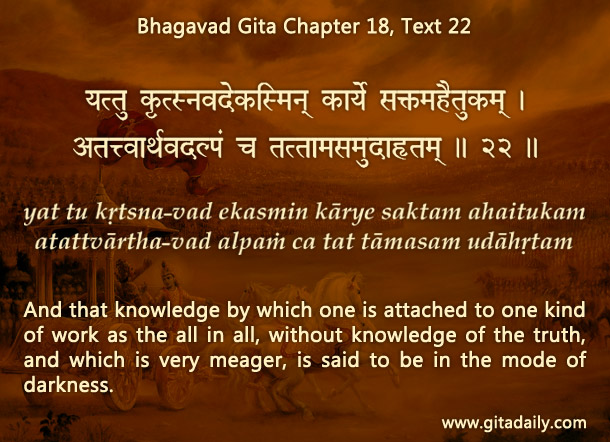
In 18.22, Krishna describes a kind of knowledge that takes one fragment of reality to be the whole. Instead of recognizing reality in its fullness and complexity, it clings to one limited conception as though that conception explains everything.
That’s what ideological indoctrination often does. Instead of expanding our ideas to understand the world, we reduce the world to fit into our ideas.
Secular me: So, instead of shrinking the world to fit our worldview, we need to expand our worldview to accommodate the world. And that would apply to religious and secular ideologies alike.
Religious me: Exactly. No ideology, religious or secular, should make us so certain of our understanding that we become unwilling to recognize realities that don’t fit into it.
I find in the Gita a call to humility. God is more complex than our conception of God, and God’s world is more complex than our conception of that world. After hearing Krishna describe His glories, Arjuna acknowledges in 10.15 that Krishna alone fully knows Himself.
Secular me: That sounds admirable. But has such humility actually been demonstrated in religious traditions?
Religious me: Not always. Still, I think we need to evaluate an idea in the fullness of both its conceptual breadth and its application.
Conceptually, the Gita offers a worldview that can inspire service and selflessness, elevate human consciousness, and help make this world a better place while directing us toward a better existence beyond this world.
And the Gita’s worldview itself recognizes that any idea can be approached or applied wrongly. Its framework of the three gunas—sattva, rajas, and tamas—explains how our consciousness influences our understanding and behavior. Someone governed predominantly by tamas, the mode of ignorance, can misunderstand or misuse even a good teaching.
Secular me: But by introducing such categories, are you explaining the problem or explaining away the problem?
Religious me: Both are possible, depending on how the categories are used. But I believe the Gita provides a framework for explaining a universal human problem without making sectarian exceptions.
The same framework applies to the Gita’s own followers. It doesn’t say that anyone who claims to follow the Gita is automatically free from extremism. It gives us a lens through which everyone, including those who profess allegiance to the Gita, can be critically evaluated.
Secular me: But that’s not how many followers of the Gita actually think. They blame Muslims or followers of other religions for extremism while claiming that their own tradition has never been extremist. Such claims can be challenged by historical evidence.
Religious me: Yes, but even if such people are vocal, are they necessarily representing the Gita’s teachings?
The Gita doesn’t use the modern religious categories of Hindus, Muslims, or Christians. It analyzes human nature and human behavior through the nonsectarian framework of the three gunas.
And it offers a pathway by which human beings can rise from the lower modes toward sattva, the mode of goodness, thereby fostering greater harmony and happiness in society.
Secular me: But how exactly does the Gita’s worldview help us address extremism today?
Religious me: I think it can help in three distinct ways.
Looking Beyond Labels
First, it can help us avoid the convenient but simplistic practice of labeling entire groups as evil or demoniac.
The potential for demoniac behavior exists in every human heart. It is not the specialty, much less the monopoly, of any particular community.
The three gunas exist in every group, religious or secular. What matters is which tendencies are being encouraged and empowered. Although all three gunas are present in everyone, people often operate predominantly under the influence of one guna.
The Gita’s framework suggests that we should strengthen sattva, harmonize rajas with sattva, and regulate tamas.
People influenced by sattva tend toward broad-mindedness, clarity, and a deeper understanding of reality. Those influenced by rajas have energy, ambition, and the capacity to act. That power can be used to protect and serve, or to attack and exploit. People dominated by tamas may use power destructively, seeking domination without regard for the consequences.
When those in sattva can guide those in rajas, the resulting combination of wisdom and power can restrain destructive tendencies in society. And those exercising such power must also remain alert to the tamas within themselves.
Traditionally, the ideal cooperation between brahmanas and kshatriyas represented something of this relationship between wisdom and power.
Now consider a community in which extremist voices have become dominant. Perhaps those governed by tamas are more numerous, or perhaps they have gained disproportionate influence.
The solution cannot simply be to destroy the entire community. That would be both inhumane and, in most circumstances, impractical.
A more constructive approach is to strengthen the people within that community who are influenced by sattva, and help those with the energy and influence of rajas become guided by sattva rather than tamas.
Secular me: This sounds very theoretical. Almost anything can be made to sound good in theory. But is it really applicable in the real world?
Religious me: Let me share something from an interfaith conference I attended in Washington, D.C.
After the conference, I was speaking with a Muslim participant. We had discussed various sensitive issues during the event. He made a striking observation: “It’s easier for me to talk with moderates of other traditions than extremists of my own tradition.”
His observation points toward something important.
When we recognize and appreciate the moderate, broad-minded people within any community, we increase the possibility that they will gain influence. But when we identify an entire community with its most extreme representatives, we risk sidelining and silencing precisely those people who could help reform it.
Of course, reform cannot come solely from outside. People within the tradition who have greater clarity and integrity need the courage to speak and act, and others need to support them.
Secular me: I’m still not sure how realistic this is.
Religious me: It’s certainly not easy. But consider the alternatives.
At one extreme, political correctness can lead us to dismiss extremism as the work of a tiny fringe, even when extremist attitudes have become considerably more widespread.
At the other extreme, we may equate every member of a community with its extremists.
Neither approach is adequate.
The triguna framework offers a more differentiated and potentially actionable vision. How extensively it can be implemented remains to be seen. But it gives us a way to think beyond those two extremes.
When Faith Becomes Fanaticism
Secular me: All right. What’s the second way the Gita can help?
Religious me: It can help individuals recognize that spiritual progress involves the progressive elevation of consciousness.
Rising toward sattva, and ultimately beyond sattva toward the divine, is part of that progress.
If people understand spiritual growth in this way, they may become less fixated on their particular beliefs and practices to the point of losing their clarity and humanity.
But when someone’s path to God is identified almost exclusively with strict adherence to the beliefs and practices prescribed by a religion, fanaticism becomes more likely. The stricter and more uncompromising the adherence, the stronger the faith may appear.
And that creates a serious danger. Even well-intentioned religious practitioners can gradually become extremist without recognizing what is happening to them.
Secular me: I’m glad you’re acknowledging that.
There’s a saying attributed to a thinker that good people will do good things and bad people will do bad things, but for good people to do bad things, it takes religion.
Religious me: I think that is a convenient explanation from an atheistic perspective, but it identifies the problem too narrowly.
I would say that what makes otherwise decent people do terrible things is not necessarily religion. It is indoctrination.
Consider communism. People could be indoctrinated into believing that loyalty to the state was so important that informing on their own family members became a glorious proof of ideological commitment—even if those family members were subsequently imprisoned, deported, or executed.
That is an example of ideology deadening ordinary human concern.
Even environmental activism, which often arises from a legitimate concern for the planet, can sometimes become extreme. Some activists become so convinced of the righteousness of their cause that they justify disrupting ordinary life or targeting monuments and works of art.
Secular me: That’s an interesting example. I’ve seen forms of environmental activism in which people appear completely convinced of their own righteousness. I’m uncomfortable with that too.
Religious me: Whatever cause we espouse, if our commitment to it becomes a justification for harmful behavior, we need to question the kind of understanding guiding us.
That brings us back to Bhagavad Gita 18.22. When one fragment of reality becomes so all-important that everything else is disregarded, we are moving toward the mentality Krishna describes as knowledge in ignorance.
Secular me: But couldn’t that happen even while following bhakti spirituality as taught in the Bhagavad Gita?
Religious me: Yes, it could. But perhaps the Gita itself gives us a way to recognize and correct that danger.
Consider Bhagavad Gita 12.13–20, where Krishna describes the qualities that make a devotee dear to Him.
What is striking about these verses is that they don’t focus on rigid adherence to rituals or strict conformity with religious beliefs.
They focus on character and behavior.
Krishna speaks of a devotee who is non-envious, who is a well-wisher of everyone, who is forgiving, who remains equipoised, and who neither disturbs others nor becomes disturbed by them.
These are qualities of a well-integrated human being who can contribute positively to society.
Secular me: That’s quite similar to what many people who describe themselves as spiritual but not religious say nowadays: “Don’t tell me what you believe; show me how you behave.”
Religious me: Yes. And perhaps their disillusionment with religious people who profess lofty beliefs but behave badly points toward the very danger the Gita is cautioning us against.
In fact, something about these verses strikes me more clearly as we discuss this.
They come at the conclusion of the Gita’s middle six chapters, which are often considered its bhakti section.
The Gita doesn’t conclude that section by describing extraordinary mystical experiences, divine miracles, or unquestioning conformity to religious authority.
It concludes by describing the qualities of a person who is dear to God—qualities that are reflected in how that person relates to others.
So the Gita’s presentation of devotion includes a demanding test of character. Religious commitment cannot be evaluated merely by what people profess or practice. We also need to consider what kind of human beings they are becoming.
Secular me: That does seem significant. But even if sattva is desirable, is it realistic to expect everyone to become sattvic?
Religious me: Probably not. But perhaps everyone doesn’t need to be in sattva for society to improve substantially.
Even if a minority of people are genuinely sattvic, they can make a significant difference if they are influential, respected, and regarded as role models—especially by those whose energy and ambition are shaped by rajas.
The Gita’s spiritual worldview offers both reasons and resources for people to rise toward sattva.
Secular me: What do you mean by reasons?
Religious me: The Gita teaches that we are, at our core, spiritual beings. As we come closer to our spiritual nature, we can discover a deeper source of happiness and fulfillment within ourselves.
Sattva helps bring us closer to that inner clarity and satisfaction.
And the more people find fulfillment within, the less they may feel compelled to seek validation through external power, control, and domination.
That provides a positive motivation for developing goodness, rather than merely a prohibition against wrongdoing.
How Our Conception of God Can Help
Secular me: And what is the third contribution of the Gita’s worldview?
Religious me: It can help us understand how different conceptions of God can positively influence people at different levels of consciousness.
Secular me: But devotion can also be destructive.
Consider suicide bombers. If extremists didn’t believe that dying for their cause would earn them a reward in paradise, perhaps some of them would never undertake such attacks.
Religious me: That’s a serious concern. But willingness to die for a cause is not unique to religious belief.
The LTTE in Sri Lanka, a largely secular separatist organization, made extensive use of suicide attacks. And during the Second World War, Japanese kamikaze pilots undertook missions from which they were not expected to return.
People can become willing to sacrifice their lives for political, nationalistic, or other ideological causes, especially when they have been deeply indoctrinated.
So the problem cannot be reduced simply to belief in a reward after death.
But your objection raises a more important question: What kind of understanding of God are we encouraging?
If spiritual growth is understood in terms of the progressive elevation of consciousness—from tamas through rajas toward sattva, and ultimately beyond the gunas—then our conception of God can help people move forward from wherever they are.
Belief in God can influence people at different levels of consciousness.
For someone governed by tamas, belief in an all-seeing, all-powerful God who holds people accountable may act as a deterrent against wrongdoing.
For someone influenced by rajas, belief in God as the ultimate fulfiller of desires can encourage a relationship with Him that gradually regulates and redirects material ambitions.
For someone in sattva, God can be appreciated as the source of wisdom, meaning, and inner satisfaction. Such a person may feel inspired to serve God out of duty and, ultimately, out of love.
Secular me: But isn’t using fear of God to control people itself problematic?
Religious me: It certainly can be, especially when those invoking God’s authority use that fear to control others for their own benefit.
Interestingly, even Voltaire, who was fiercely critical of religious fanaticism, recognized that belief in God could restrain wrongdoing. He argued that belief in divine accountability could discourage people from committing crimes they might otherwise expect to get away with.
Secular me: But isn’t that a rather cynical, utilitarian view of religion?
Religious me: It is certainly a limited view. But the fact that belief in God can restrain wrongdoing doesn’t mean that restraining wrongdoing is its highest purpose.
The Gita offers a progression. A person may initially approach God out of fear or desire. With spiritual growth, that relationship can become increasingly guided by understanding, duty, gratitude, and ultimately love.
At its culmination, devotion is not simply about avoiding punishment or obtaining rewards. It is about discovering that loving connection with the divine can fulfill our heart’s deepest longing for lasting love.
Secular me: I found your three suggestions about addressing extremism helpful.
Religious me: And you helped me appreciate the difference between a religious commitment that emphasizes conformity to beliefs and practices and one that emphasizes the development of consciousness and character.
Secular me: Thank you.
Religious me: Thank you too.
A Prayer for Harmony Within
As the two parts of me arrived at a mutually respectful understanding, I felt the knot of tension within me gradually dissolving.
The secular part of me had not abandoned its questions. Nor had the religious part of me abandoned its convictions. But through their interaction, both had contributed to a more discerning understanding.
Feeling grateful, I offered a prayer:
My dear Lord, help the different parts within me play their respective roles harmoniously in my journey through this world toward You. May the secular part of me remain a voice of reason, protecting me from uncritically accepting whatever is done in the name of religion. May the religious part of me remain firmly committed to You without becoming fanatical or dismissing the valid concerns of the secular part. May neither part silence the other, and may both help me grow in understanding, character, and devotion. May all that is within me work together to bring me closer to You.
***
18.22 And that knowledge by which one is attached to one kind of work as the all in all, without knowledge of the truth, and which is very meager, is said to be in the mode of darkness.
Unexplored areas and application of BG is amazing pr ji. End of the day devotees of deep knowledge Brahmana, Vaishnavas should become leaders of the society.
With Shudras in power what can be expected…. Only chaos !!(
It’s an eye opener that even a half baked devotee has the risk of becoming extremist in his views and actions.