
The Bhagavad Gita explains that the soul transitions from one body to another, just as a person progresses from childhood to youth to old age. Fascinatingly, documented cases of past-life memories and physical birthmarks provide compelling evidence for this ancient spiritual concept.
Children sometimes recall specific, verifiable details about previous families, asking for their “other mom” or describing places and people they have never physically encountered in their current lives. One well-documented example involves a young boy in Turkey named Kieran. He described his previous life in a town called Merson. Although his current family had never been there, Kieran successfully guided his parents to an exact house in Merson.
There, they met a widow who confirmed the highly specific details Kieran had mentioned. The young boy recognized her as his wife from his previous life and detailed a violent incident in which his past self was attacked and killed with a knife. Remarkably, Kieran possessed a birthmark on his body that matched the exact location of the fatal knife wound from his previous life.
These cases were extensively studied by Dr. Ian Stevenson, a researcher who observed the incredibly low statistical probability of such precise correlations between birthmarks and fatal past-life wounds. Furthermore, this phenomenon extends beyond mere memory into actual behavior. For instance, young Kieran reacted with intense, adult-like anger when he saw his former wife with another man—a behavioral response far beyond that of a typical six-year-old child.
These phenomena point to the existence of a non-material consciousness—the soul—that carries memories, behavioral traits, and even physical imprints across different physical bodies, perfectly aligning with the Gita’s teachings on reincarnation.
***
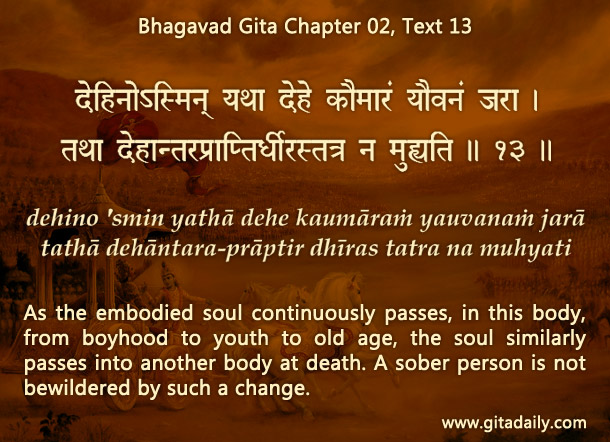
02.13 As the embodied soul continuously passes, in this body, from boyhood to youth to old age, the soul similarly passes into another body at death. A sober person is not bewildered by such a change.
Leave A Comment